

Travelers must be screened at one of three U.S. airports before returning home.


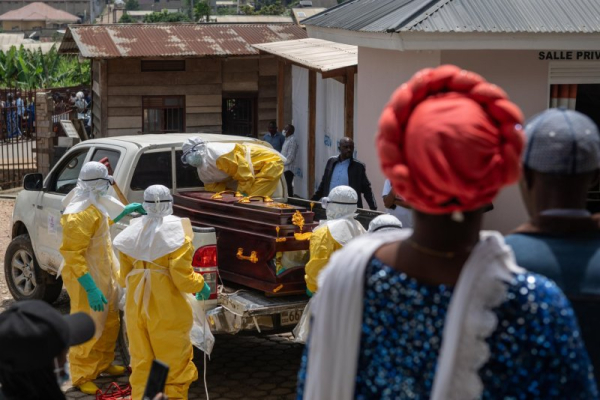
Health workers wearing full personal protective equipment on Saturday prepare to transport the body of person who died of Ebola for a safe burial at Sofepadi Hospital in Bunia, Ituri province, in the Democratic Republic of the Congo. Photo by EPA
The Centers for Disease Control and Prevention on Saturday added two more airports that travelers to the United States can be routed through for Ebola screening when entering the country.
The enhanced travel screening announced earlier this week by the CDC and the Department of Homeland Security is meant to screen people for the virus on entry to the country if they have been in the Democratic Republic of Congo, South Sudan or Uganda.
The outbreak, which started in the DRC and has spread to neighboring South Sudan and Uganda, is estimated to have 750 suspected cases and 177 suspected deaths, the World Health Organization on Friday said, adding that the “real scale of the outbreak is likely far larger.”
The CDC first issued restrictions on Thursday for Americans returning to the United States to be screened at Washington Dulles International Airport in Washington, D.C., before continuing on to their final destinations.
The two additional airports will be Hartsfield-Jackson Atlanta International Airport, which started to accept travelers at 11:59 p.m. EDT on Friday, and George W. Bush Intercontinental Airport in Houston, which will start to accept travelers on Tuesday, May 26, at 11:59 p.m. EDT, the CDC said on Saturday.
“These travelers will have their air travel re-routed to arrive at select airports,” CDC officials said in the update.
The enhanced health screening includes being escorted to a designated screening area; completing a questionnaire about their travel history and symptoms; having their temperatures checked using non-contact thermometers; and observation by CDC staff for signs of illness.
“Travelers with fever or other symptoms that could be Ebola will receive additional evaluation by a CDC public health officer,” the agency said.
“If the assessment shows that a traveler may be sick with Ebola, the traveler will be transferred to a hospital for further medical evaluation,” it said.
The WHO on Friday raised the national risk assessment during the outbreak in the DRC to “very high,” but officials said that global risk for infection with the Bundibugyo strain of the Ebola virus, for which there is no approved vaccine.
WHO Director-General Tedros Adhanom Ghebreysus during a meeting on Friday thanked the efforts of neighboring nations in Africa who have assisted during the outbreak, as well as the various regional and global health agencies that also have done so.
Although the United States last year pulled out of the WHO, the U.S. State Department said on Saturday that it has activated a dedicated Ebola Response Task Force that is led by “senior experts with direct experience managing prior Ebola outbreaks” in 2014 and 2018.
The department also has deployed a Disaster Assistance Response Team and provided $32 million in assistance to U.S. partners in the region, it said in a press release.
This week in Washington
Kevin Warsh takes the oath of office as he is sworn-in as the new chairman of the Federal Reserve by Supreme Court Associate Justice Clarence Thomas in the East Room of the White House on Friday. Photo by Yuri Gripas/UPI | License Photo
[kicker]
