


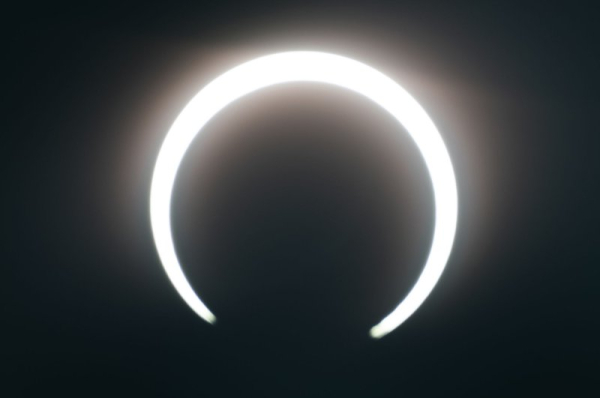
The moon partially covers the sun during an annular “Ring of Fire” solar eclipse near Bluff, Utah, on October 14, 2023. File Photo by Bob Strong/UPI | License Photo
The first solar eclipse of 2026 arrives Tuesday, but it won’t be the kind that most people are familiar with.
On Feb. 17, the moon will pass between Earth and the sun to create an annular solar eclipse, often called a “ring of fire.” In an annular eclipse, the moon is a bit farther from Earth than average, so it looks slightly smaller in the sky and can’t cover the sun completely. At peak, a bright ring of sunlight remains visible around the moon’s silhouette.
|
A similar “ring of fire” eclipse crossed parts of the Americas on Oct. 14, 2023, drawing crowds across a wide swath from Oregon to Texas. |
Where will Tuesday’s eclipse be visible?
The path where the full ring effect is visible will track over a remote part of Antarctica and surrounding waters, including the southern Indian Ocean.
Even though most people won’t be in the right place to see the full “ring of fire,” some may voyage great distances to be in the path on Tuesday.
When is the next total solar eclipse?
The next total solar eclipse is on Aug. 12, when the moon will fully cover the sun along a narrow path crossing parts of Greenland, Iceland and Spain.
That will be the first total solar eclipse anywhere in the world since April 8, 2024, when totality swept across North America.
For the United States, the next total solar eclipse with totality crossing U.S. soil is March 30, 2033, with the path running through Alaska. The next total eclipse to touch the contiguous U.S. is expected on Aug. 23, 2044.
Annular solar eclipse occurs in U.S.
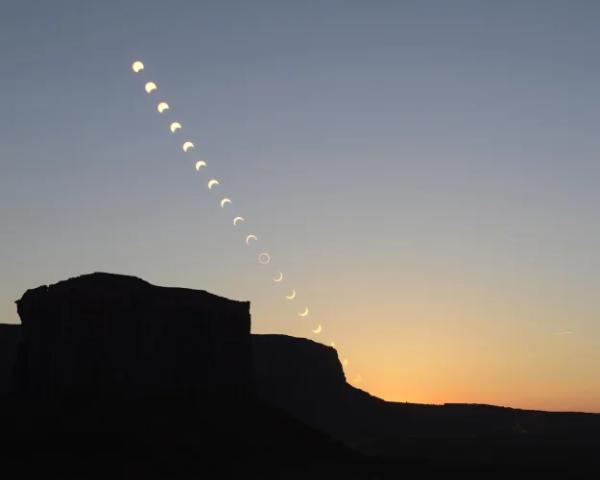
Following an orbital path from China and Japan through wester Texas, the moon passes in front of the sun creating an annular eclipse in the skies over Monument Valley National Park, Arizona on May 20, 2012. This timelapse, composite image shows the many phases of the event as the sun descended beyond the buttes in the mid-western sky. .UPI/Joe Marino-Bill Cantrell | License Photo
