


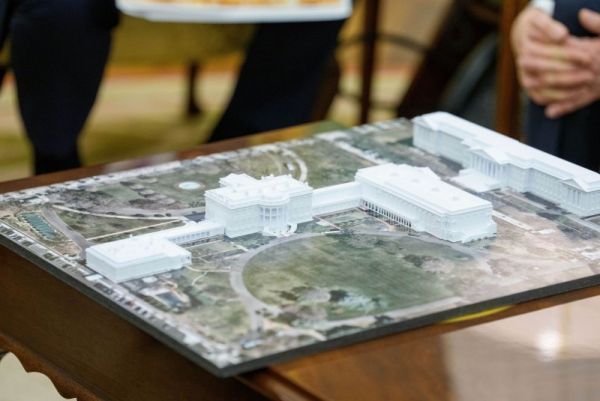
1 of 2 | President Donald Trump shows a rendition of the East Wing with the new White House Ballroom in October. An appeals court ruled Saturday that construction can continue on the ballroom. File Photo by Aaron Schwartz/UPI | License Photo
A panel of judges said Saturday it will allow construction on the White House ballroom to continue for now.
The panel of three judges in the U.S. Court of Appeals for the D.C. Circuit told the lower court judge who halted the project to seek
In an earlier filing, the Trump administration said that stopping construction “would imperil the President and national security, and indefinitely leave a large hole beside the executive residence.”
The planned construction includes bomb shelters, a hospital, medical area and other “top secret military installations, structures and equipment,” the administration said.
Construction of the 90,000-square-foot building began with the demolition of the East Wing of the White House in October. The new building was to cost $200 million, but the ballroom’s price tag has since doubled. Trump said it will be financed by private donors.
U.S. District Judge Richard Leon for the District of Columbia halted the work on April 1.
“The President of the United States is the steward of the White House for future generations of First Families. He is not, however, the owner!” Leon said in his opinion.
The appeals court said work on the project can continue until at least April 17.
“It remains unclear whether and to what extent the development of certain aspects of the proposed ballroom is necessary to ensure the safety and security of those below-ground national security upgrades or otherwise to ensure the safety of the White House and its occupants while the appeal proceeds,” the judges in the majority wrote.
The judges, Patricia Ann Millett, Bradley Garcia and Neomi Rao, were not unanimous. Rao dissented, arguing that the National Trust for Historic Preservation lacked standing to sue.
Trump has also said that the military was building a “massive complex” under the ballroom, but he hasn’t released any details.
The National Trust told the appeals court that Trump was confusing the above-ground ballroom with the below-ground bunker.
“As is obvious, the absence of a massive ballroom on White House grounds has not stopped this (or any other) President from residing at the White House or hosting events there,” the lawyers said in a filing. “Temporarily halting the ballroom project until it complies with the law will not irreparably harm defendants or the nation.”
Justice Department lawyers had asked the court to shelve Leon’s ruling.
“The upgrades to the East Wing are not cosmetic; instead, they involve the use of missile-resistant steel columns, beams, drone-proof roofing materials, and bullet-, ballistic- and blast-proof glass windows,” they said in a filing. “They also include the installation of bomb shelters, hospital and medical facilities, protective partitioning and top-secret military installations, air conditioning, heating, venting and more.”
On April 2, The National Capital Planning Commission voted Thursday to approve Trump’s plans for the White House ballroom. Though, that vote doesn’t override the court’s rulings.
