
In 1980, ship crashed into Sunshine Skyway over Tampa Bay, killing 35

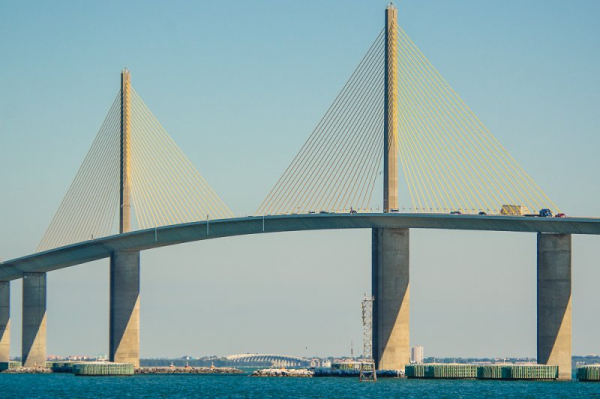
1 of 2 | The Sunshine Skyway Bridge in Tampa, Fla., was rebuilt in 1987 after the original bridge collapsed in 1981. A freighter struck a support post during a storm, collapsing the southbound span. A Greyhound bus and seven other vehicles were plunged into the water, killing 35 people. File Photo by Robert Neff/Wikimedia Commons
The catastrophic collapse of the Francis Scott Key Bridge early Tuesday morning over Baltimore’s Patapsco River, where six people remain missing and are now presumed dead, is drawing tragic comparisons to a similar bridge collapse in Florida 44 years ago.
On the morning of May 9, 1980, a freighter slammed into the support columns of the old Sunshine Skyway bridge in Tampa Bay during a violent thunderstorm, causing a 1,300-foot section of the southbound span to collapse. A Greyhound bus and seven other vehicles plunged into the waters, where 35 people died. Only the driver of a pickup truck survived the drop. Advertisement
In Baltimore, a Singapore-based cargo ship is reported to have issued a mayday early Tuesday morning after losing power. Crews performing pothole work on the bridge alerted drivers to stop the flow of traffic as the ship crashed into a support column collapsing much of the span and sending eight people into the water. Two were rescued as a search continued for the other six until late Tuesday, when it was called off. Advertisement
Both bridge collapses involved freighters hitting support columns, collapsing much of the span, and plunging vehicles and people into the waters below. Both bridge collapses cut off a major arterial for the community and for shipping. And both spans that collapsed opened in the 1970s.
As investigators gather in Baltimore to determine what happened Tuesday, the question is what lessons learned from Florida’s tragedy decades ago could have made a difference this week.
Post-disaster findings
In Florida’s bridge collapse, the pilot of the ship, John Lerro, ultimately was cleared of negligence and the collision was deemed an “accident.” During months of hearings, Lerro maintained that he had no control over the freighter and was at the mercy of the 70 mph winds as he navigated through the 800-foot-wide opening under the twin bridge spans.
“We believe he made a reasonable decision of attempting to transit under the bridge, in view of his fear of slamming into the bridge broadside,” chief NTSB investigator Douglas Rabe said in 1981. Investigators ultimately determined the weather service should have warned mariners of the severe storm and that Lerro should have abandoned his attempt to navigate under the Sunshine Skyway Bridge.
While Tuesday’s bridge collapse is still early in the investigation, there are reports that the crew aboard the cargo ship Dali issued a “mayday,” saying the vessel had lost power, before is slammed into one of the support piers of Baltimore’s Francis Scott Key Bridge. Advertisement
If confirmed, both bridge collapses would have come after crews lost control of their vessels before striking unprotected piers.
Engineering protective barriers
On Tuesday, engineers and bridge designers raised questions about the structural safety of Baltimore’s bridge and whether protective barriers around the support columns would have prevented the tragedy.
British structural engineer and bridge designer Ian Firth told The Baltimore Sun that protective barriers include cable systems, pontoons, caissons and submerged islands. Firth said the most commonly used protection for bridge support columns are bumpers or “dolphins,” which are filled with sand or concrete to protect the bridge from cargo ships.
When the Sunshine Skyway was rebuilt in 1987 at a cost of $240 million, engineers added dolphins mounted to artificial islands to protect the bridge from “potential water-traffic collisions.” The six piers, closest to the shipping channel in Tampa Bay, are protected and the two main piers are flanked by 60-foot bumpers, called dolphins, which can withstand an impact of up to 30 million pounds.
While Florida’s bridge was rebuilt with protective bumpers in 1987, Maryland’s Francis Scott Key Bridge opened 10 years earlier in 1977. Codes for building bridges and their structures have changed over the years and vary state by state to accommodate vehicle traffic above and maximum access for water traffic to traverse underneath. Advertisement
Benjamin Schafer, a professor of civil and systems engineering at Johns Hopkins University told The Baltimore Sun that protecting the bridge piers, in the unlikely event that a large freighter is unable to navigate, could have made a difference Tuesday for the Francis Scott Key Bridge.
“This sort of protection is what FSK did not have, and we can see now that it may — may — have helped,” Schafer said.
