



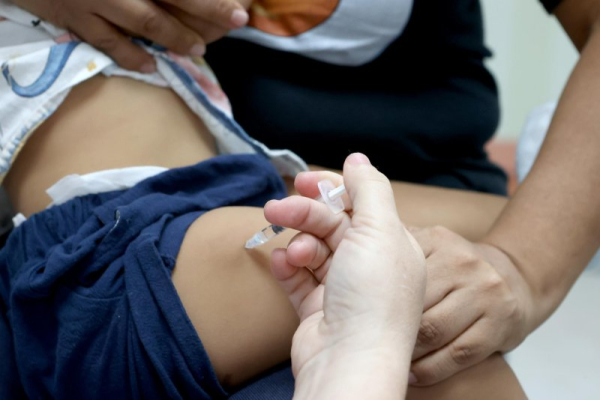
A nurse administers a measles vaccine to a child at a public health center in Nejapa, El Salvador, in April. The United States just reached a record high of measles cases this year. File Photo by Javier Aparicio/EPA
Measles cases have hit a record high in the United States since the virus was declared eliminated in 2000, the Centers for Disease Control and Prevention said.
The CDC said there have been 2,318 confirmed cases of measles so far this year, which beats last year’s record-breaking number of 2,289. Last year, two unvaccinated children died of the disease. More measles cases have been reported in the United States in the past two years than in all the years from 2000 through 2024 combined, The New York Times reported.
In November, a panel of experts will meet to decide if the United States has lost its status as a country that has “eliminated” the disease.
“This is just going to keep happening,” Jennifer Nuzzo, director of the Pandemic Center at the Brown University School of Public Health, told The Times. “It’s going to mean living in a perpetual state of vulnerability and risk until we get vaccination levels up.”
Last year, the largest outbreak was in South Carolina, and many of this year’s cases stem from that event. It was declared to have ended in April. Now, there’s an outbreak that started last summer along the Utah-Arizona state line and has spread throughout the Beehive State. More than 100 cases have also been reported in Lancaster County, Pa., this year.
The CDC reported 35 new measles outbreaks this year.
Measles is especially good at finding pockets of people with weak immunity.
“It’s going to find people who aren’t immune,” Dr. David Kimberlin, a pediatric infectious disease expert at the University of Alabama at Birmingham, told The Times. “It’s like a heat-seeking missile.”
Funding cuts to public health are also a concern.
Dr. Farrell Tobolowsky, medical director the San Francisco Department of Public Health’s communicable disease program, said two cases this year meant activating several contract tracing investigators.
“I don’t think our department can currently handle more than one (case) without calling in additional staff,” Tobolowsky said at a briefing hosted by the Big Cities Health Coalition, CNN reported.
“It is something that we’re concerned about all the time and is on our minds all day, every day,” she said. “Not only if there’s another measles case, but if anything else comes that is of high consequence at the same time, it will be difficult to manage two things at once.”
Courtney Spencer, a spokesperson for the Department of Health and Human Services, said the department has mounted an “aggressive outbreak response,” and said it’s given $8.5 million to states to help contain outbreaks.
She added that the department has said, “[The measles, mumps and rubella] vaccination remains the best protection against measles.”
But other professionals blame the federal government for at least part of the spread.
“We have seen virtually no national messaging. We’ve seen no ad campaigns,” Dr. Jonathan Temte, a former chair of the CDC vaccine advisory committee, said of HHS. “I think that really tells us something about their priorities.”
Dr. Andrew Racine, president of the American Academy of Pediatrics, called it a failure: “This essentially is a public health failure, and it’s avoidable.”
