


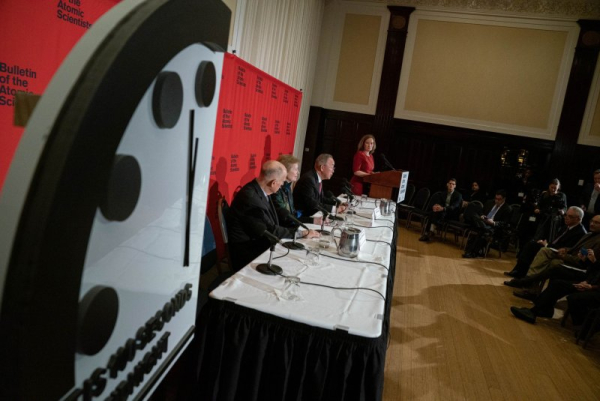
1 of 5 | A group of international leaders spoke about the Doomsday Clock in 2020. The Bulletin of the Atomic Scientists cite worsening nuclear threat, lack of climate action, autocracy and lack of artificial intelligence safety as the reason to move the clock to 85 seconds to midnight. File Photo by Ken Cedeno/UPI | License Photo
The symbolic Doomsday Clock managed by the Bulletin of the Atomic Scientists, has been moved forward by 3 seconds this year, making it now 85 seconds to midnight.
On Tuesday, the group released its annual warning. It said that global leaders didn’t heed last year’s warning, moving the Earth closer to global catastrophe due to man-made causes.
“Rather than heed this warning, Russia, China, the United States, and other major countries have instead become increasingly aggressive, adversarial, and nationalistic,” the Bulletin’s statement said. “Hard-won global understandings are collapsing, accelerating a winner-takes-all great power competition and undermining the international cooperation critical to reducing the risks of nuclear war, climate change, the misuse of biotechnology, the potential threat of artificial intelligence, and other apocalyptic dangers.”
The group of atomic scientists said world leaders have become unconcerned.
“Far too many leaders have grown complacent and indifferent, in many cases adopting rhetoric and policies that accelerate rather than mitigate these existential risks,” it said.
Doomsday Clock began at 7 minutes to midnight in 1947 as a way to convey the threat of nuclear danger. In 1949, as the global nuclear arms race began, the clock jumped to 3 minutes to midnight. The Test Ban Treaty in 1963 jumped the clock to 12 minutes to midnight.
It moved back and forth throughout the 1970s and ’80s, until 1991 — the end of the Cold War — kicked it back to 17 minutes to midnight, the farthest it’s been from “doomsday.”
In 2023, the clock was at 90 seconds, and 2025 pushed it to 89 seconds.
The Bulletin’s areas of concern this year are: nuclear risk, climate change, biological threats and disruptive technologies.
The Bulletin said that last year “started with a glimmer of hope” as new President Donald Trump worked to end the war in Ukraine and “even suggested that major powers pursue ‘denuclearization.'” But, “Russian allusions to nuclear weapons use,” conflict between India and Pakistan, as well as bombings of Iran nuclear facilities dashed that hope.
The climate is showing signs of suffering as well.
“Energized by warm temperatures, the hydrologic cycle became more erratic, with deluges and droughts hopscotching around the globe,” the Bulletin said. Droughts in Peru, the Amazon and Africa caused concern, as well as more than 60,000 heat-related deaths in Europe and record rainfall in Brazil.
Responses to the climate emergency went from “insufficient to profoundly destructive,” the Bulletin said. “None of the three most recent U.N. climate summits emphasized phasing out fossil fuels or monitoring carbon dioxide emissions. In the United States, the Trump administration has essentially declared war on renewable energy and sensible climate policies, relentlessly gutting national efforts to combat climate change,” it added.
An “arms race” also added to the clock movement.
“Increasing numbers of nuclear warheads and platforms in China, and the modernization of nuclear delivery systems in the United States, Russia, and China,” added to the concern. “The United States plans to deploy a new, multilayered missile defense system, Golden Dome, that will include space-based interceptors, increasing the probability of conflict in space and likely fueling a new space-based arms race,” the Bulletin said.
But of most immediate concern is the “rapid degradation of U.S. public health infrastructure and expertise,” it added. “This dangerously reduces the ability of the United States and other nations to respond to pandemics and other biological threats.”
The U.S. push for AI in defense despite potential dangers added to the time change, it said.
“In the United States, the Trump administration has revoked a previous executive order on AI safety, reflecting a dangerous prioritization of innovation over safety.”
The bulletin added the rise of autocracy to the list.
Leaders of the United States, Russia, and China”all have approaches to international relations that favor grandiosity and competition over diplomacy and cooperation,” the Bulletin said.
Autocracy alone isn’t necessarily a threat, it said, but “an us-versus-them, zero-sum approach increases the risk of global catastrophe. The current autocratic trend impedes international cooperation, reduces accountability, and acts as a threat accelerant, making dangerous nuclear, climatic, and technological threats all the harder to reverse.”
