



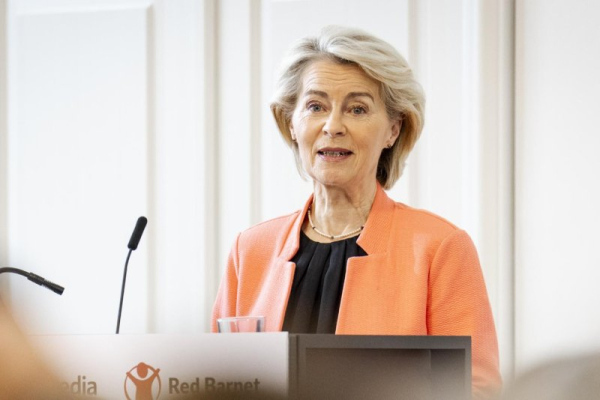
European Commission President Ursula von der Leyen delivers a keynote address at the European Summit on Artificial Intelligence and Children in Copenhagen, Denmark, Tuesday. She announced the EU will consider a law banning children from social media. Photo by Ida Marie Odgarrd/EPA
The European Union is considering a ban on social media for children, EU President Ursula Von der Leyen said at the European Summit on Artificial Intelligence and Children.
Von der Leyen said Tuesday that the bloc will take action this fall against the “addictive design” of certain platforms.
The EU has created what she called a “Special Panel of experts on Child Safety Online” and is awaiting findings from its work.
“Depending on the results, we could come with a legal proposal this summer,” she said.
“We are taking action against TikTok and its addictive design — endless scrolling, autoplay, and push notifications. The same applies to Meta, because we believe Instagram and Facebook are failing to enforce their own minimum age of 13,” Von der Leyen said in her speech in Denmark.
“The pressure can be overwhelming. And [children] are being exposed at a moment when their resilience is only just beginning to grow, because they are still children. We all know the consequences: sleep deprivation, depression, anxiety, self-harm, addictive behavior, cyberbullying, grooming, exploitation, suicide. And with the rapid advance of artificial intelligence, these risks are multiplying fast,” she said.
She said the risks are not accidental.
“They are the result of business models that treat our children’s attention as a commodity. The more attention, the higher the profit. … Young men are getting hooked on games that are designed to manipulate them into spending more and more money. Young women are targeted with beauty product ads the moment they untag themselves in a photo. These are deliberate choices by tech providers — choices made so they can profit from children’s vulnerability to cash in on their fears and moments of self-doubt,” she added.
The European Commission has developed its own app to verify age. The app has the “highest privacy standards in the world,” Von der Leyen said.
Member states will be able to use it, and online platforms will be able to enforce it.
“No more excuses — the technology for age-verification is available,” Von der Leyen said.
The EU has taken action against big tech companies in recent years. The EU and the British government have gone after Elon Musk’s Grok for allowing the artificial intelligence bot to undress women and girls in images. The EU also fined the platform $140 million for lack of transparency in its blue checkmark verification.
Countries have also created laws that ban the use of social media for children and young teens. Australia created a ban against those under 16 using social media, and Spain has announced a similar ban. France is working to pass a similar law, and other countries worldwide are considering or implementing laws.
President Donald Trump has consistently sided with tech companies. He created a travel ban against former European Union technology commissioner Thierry Breton and four other campaigners against online hate and disinformation, saying that they forced U.S. social media platforms to limit Americans’ First Amendment rights.
Trump also signed a memorandum in February threatening tariffs on countries that impose digital services taxes, which mostly includes EU countries.
Studies have shown the harmful effects of social media on children. A recent study published in the journal Pediatrics Open Science linked social media use with a reduced ability to concentrate, and another study showed that a week away from social media can ease anxiety, depression and sleep issues.
A study in the Journal of the American Medical Association showed that children between ages 9 and 13 who spent more time on social media performed worse on tests of reading, memory and language two years later. Researchers reported today in the Journal of the American Heart Association that each additional hour of screen time in children is associated with an increase in heart risk factors like blood pressure, cholesterol and blood sugar levels later in life.
Historic May moments through the years

Wreathes are seen amongst the statues at the Korean War Veterans Memorial during Memorial Day weekend in Washington on May 27, 2023. Memorial Day, which honors U.S. military personnel who died while in service, is held on the last Monday of May. Photo by Bonnie Cash/UPI | License Photo
