


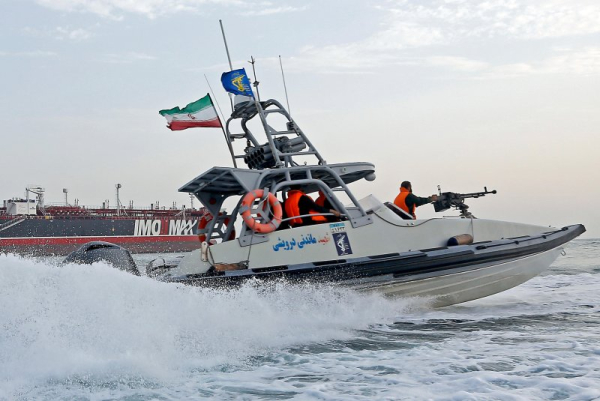
An Iranian Revolutionary Guard jet boat saileed around a seized tanker in 2019. The U.S. Department of Treasury on Tuesday sanctioned people and businesses for “shadow banking” in support of Iran. File Photo by Hasan Shirvani/EPA
The U.S. Treasury announced Tuesday that it’s sanctioning two Iranian financial facilitators and more than a dozen Hong Kong- and United Arab Emirates-based people and entities for “shadow banking” in support of Iran.
The Treasury Department alleged that these people helped coordinate funds transfers, including from the sale of Iranian oil, that benefited the IRGC-Qods Force and Iran’s Ministry of Defense and Armed Forces Logistics, a press release said.
“Iranian entities rely on shadow banking networks to evade sanctions and move millions through the international financial system,” Under Secretary of the Treasury for Terrorism and Financial Intelligence John K. Hurley said in a statement. “Under President [Donald] Trump’s leadership, we will continue to disrupt these key financial streams that fund Iran’s weapons programs and malign activities in the Middle East and beyond.”
The department said that between 2023 and this year, Iranian nationals Alireza Derakhshan and Arash Estaki Alivand worked to facilitate the purchase of over $100 million worth of cryptocurrency for oil sales for the Iranian government. Derakhshan and Alivand used a network of front companies in foreign jurisdictions to transfer the cryptocurrency funds, the release said.
The two are now “blocked,” meaning all their assets in the United States will be seized, and Americans and their companies can’t do business with them or their businesses.
Besides Derakhshan and Alivand, the department named several other people and businesses that are now blocked from American trade.
Shadow banking is credit intermediation by entities outside the regular banking system, performing bank-like functions, such as maturity transformation and liquidity transformation, without the same strict regulatory oversight as traditional banks.
Since returning to the White House in January, Trump has reinstated his so-called maximum pressure campaign of his first administration, which failed in its goal to coerce Iran back to the negotiating table on a new nuclear deal by imposing punitive measures, including sanctions, targeting Tehran.
With the resumption of the maximum pressure campaign, Trump has been seeking to eliminate Iran’s oil exports.
“The United States remains committed to disrupting illicit funding streams financing Iran’s malign activities,” State Department spokesman Tommy Pigott said in a statement.
“As long as Iran devotes its illicit revenues to funding attacks on the United States and our allies, supporting terrorism around the world and pursuing other destabilizing actions, we will continue to use all the tools at our disposal to hold the regime accountable.”
More than a dozen rounds of sanctions targeting individuals and entities linked to Iran have been imposed by the second Trump administration.
Those imposed Tuesday are the second tranche targeting what the Trump administration describes as a shadow banking network since the resumption of the maximum pressure campaign in February.
Britain, Germany and France sent a letter in late August to the United Nations Security Council saying they are starting the 30-day process of “snapback” of sanctions against Iran.
The snapback mechanism is used to re-impose sanctions on Iran in the event of “significant non-performance” of treaty commitments. The sanctions were suspended under the 2015 Joint Comprehensive Plan of Action nuclear deal.
