



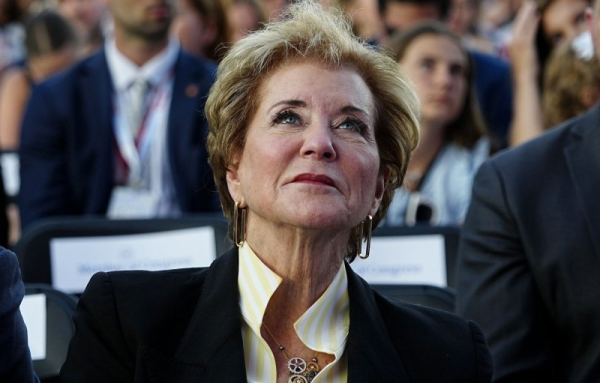
1 of 6 | Education Secretary Linda McMahon emailed department employees in March 2025, telling them that she would lead the agency as it embarked on its “Final Mission.” Photo by Bonnie Cash/UPI | License Photo
A flurry of interagency agreements are moving parts of the Department of Education to other federal agencies, reshaping the landscape for students, states and institutions of learning.
Education Secretary Linda McMahon emailed department employees in March 2025, telling them that she would lead the agency as it embarked on its “Final Mission.”
That mission, as McMahon described it: “an overhaul-a last chance to restore the culture of liberty and excellence that made American education great.”
To date, the department is carrying out this overhaul by moving its functions and programs to multiple federal agencies.
Career and Technical Education offices and youth workforce development will fall under the scope of the Department of Labor.
The Bureau of Indian Education and tribal school operations and support programs are moving to the Department of the Interior.
The Office of Civil Rights is moving to the Justice Department.
The Office of Special Education and Rehabilitative Services is moving to the Department of Health and Human Services, along with Early Childhood Technical Assistance Centers and family engagement and community support.
The State Department is assuming control over international student exchange programs and global education initiatives and partnerships.
Programs and services are being shifted through interagency agreements. By law, eliminating cabinet-level departments and redirecting congressionally approved funds requires an act of Congress. Yet, the Trump administration has used interagency agreements to skirt congressional authority, Jill Siegelbaum and Emily Merolli, partners at Sligo Law Group, PLLC, told UPI.
“The main statutory concern that I see here is that I am not aware of any authority within the department that allows the secretary of education to delegate responsibilities and functions outside of the Department of Education,” Siegelbaum said. “They don’t actually cite the statutory authority that allows them to enact these agreements except for this vague contracting authority which these clearly do not fall within the scope of those authorities.”
Sligo Law Group filed for a preliminary injunction to stop the Department of Education from terminating community school grants in April. The lawsuit alleges the department’s decision to end two community school grants for a total of $18.5 million violates the Administrative Procedures Act.
“What we’re seeing is a department that is not interested in negotiating or improving outcomes,” Merolli said. “We’re seeing a department that is interested in pushing its own priorities and terminating and canceling based on a number of pretty ill-defined and sometimes arbitrary delineations. What we’re going to see moving forward with this latest round of transfers is more of a move to just an enforcement-side posture.”
That enforcement-side posture is also what Eric Duncan sees from the Office of Civil Rights moving to the Justice Department. Duncan, director of P-12 policy for EdTrust, told UPI the Office of Civil Rights has already taken a new approach to complaints under the Trump administration.
“Previous administrations didn’t necessarily see the department saying, ‘We are investigating you and if you don’t make changes to programs we will withhold federal funding, we will use punitive measures to drive folks to policies we want to prioritize,'” Duncan said.
The office has already fallen under a backlog of cases that have not been answered to, Duncan said.
In March 2025, about half of the Office of Civil Rights’ staff was placed on paid administrative leave and seven of its 12 regional officers were closed. In December, those staff members were recalled, though the department said it was able to handle its workload without those staff members in the interim.
The Government Accountability Office reported earlier this year that between March and September 2025, the Office of Civil Rights received more than 9,000 complaints of alleged discrimination and resolved 7,000 of them. Those resolutions were reached by dismissing 90% of those claims.
Meanwhile, the administration’s interpretation of Title VI of the Civil Rights Act has changed how the federal government applies and enforces the law while the Justice Department focuses more on punishment than resolution.
Title VI prohibits discrimination based on race, color or national origin in programs and activities that receive federal funding, including schools and colleges.
In December, the Justice Department announced that it was eliminating the disparate impact test from its rules for enforcing Title VI. It did so without opening the rule change up to public comment and review as required by the Administrative Procedures Act.
The disparate impact test is a legal standard used to determine if a policy or practice disproportionately affects a protected group.
“The administration hasn’t gotten a court decision on their interpretation of Title VI,” Duncan said. “The court has not said anything about their interpretation of Title VI and how it applies to race-conscious programming or practices that the Department of Justice is now being more punitive of and going after these programs they deem to have anything to do with race.”
The administration has backed away from addressing systemic inequities that affect minority students in the government-wide charge against Diversity, Equity and Inclusion initiatives. In an executive order on his first day back in office. President Donald Trump declared an end to DEI programs, calling them “illegal.”
Moving offices like the Office of Civil Rights also raises concerns for Duncan about complaints falling through the cracks and gaps in service. A majority of the complaints the Office of Civil Rights received were in relation to special education, which now falls under the purview of Health and Human Services.
“The way the Department of Education was really structured was to have the capacity to hear those claims but also to help school districts and states with some of the systemic issues they’re seeing,” Duncan said. “It just fragments it even more and puts it in an agency that doesn’t necessarily have the expertise or functions to provide timely support and support that does not just support the individuals that need it in real time but also look at the entire set of learning conditions and provide necessary recommendations.”
McMahon has described the purpose of these moves as an effort to eliminate “bureaucratic bloat” and improve efficiency. Leslie Davis Hiner, senior adviser for legal policy for the organization EdChoice, told UPI she believes the description is accurate.
“What the Department of Education is doing now, they’re stepping up to say we could do this a little better,” Hiner said.
Hiner added that for some of the program moves, such as shifting Career and Technical Education to the Department of Labor, the function of the program better suits the core competency in that department.
“We’re going to find that in these key areas, service and effectiveness of that work will improve tenfold,” she said. “This is very positive.”
Ultimately, Hiner said, the Department of Education’s sole focus should be on delivering education to students. She believes this overhaul, as McMahon described it, is about shedding responsibilities that are not directly tied to that one purpose.
“Over the years, we’ve piled a lot of this kind of responsibility into the Department of Education with this idea that because it involves schools, well then the Department of Education has to handle that,” she said. “Their core competency is and should be to ultimately help the states figure out how to properly educate kids. These other things that will impact a child’s learning are very significant but they’re separate issues of professional competence. This will move us a long way to that.”
Rachel Gittleman, AFGE Local 252 union president, told UPI the questions and concerns she hears from members say these transitions have not been efficient and are not making education better for states.
“The big one is, ‘Why are we doing this?'” Gittleman said of the most common questions she has been receiving. “Just take the returning education to the states piece. All of these changes are making it harder for the states to get the money and resources and support that they have historically gotten from the Department of Education.”
Gittleman added that the department has long been the smallest cabinet-level agency in the government and has also been the most efficient when it comes to “dollars in versus dollars out” delivery of service. Yet about half of the agency’s workforce was reduced during DOGE cuts and shakeups in the department.
“Massive loss of expertise,” Gittleman said. “Actually the department is embarking on a huge hiring spree right now. A lot of positions that they are hiring for are positions that were riffed and terminated last year because they do not have the bandwidth to be able to do the statutorily required functions that are required of the department.”
Staff being physically moved to different government buildings has also created challenges for employees and questions about who to go to with technical problems.
“On the efficiency side of things I can point to a myriad of places where we are just adding more bureaucracy,” Gittleman said.
One such example of weakening efficiency comes from the system that the Department of Education uses. It has long used a system called G5, which is used for all department funding functions outside of student loans. It is a proprietary system that the department uses for free.
The system that is used by the Department of Health and Human Services and Department of Labor is called Grants Management Solutions. It is made up of three systems that are used together. It also costs the Department of Education money to use.
Despite the changes to the department, Gittleman remains hopeful that what has been done can be undone.
“I wouldn’t be in this job if I didn’t believe this could be undone,” she said. “There’s a lot of conversations happening right now, not just at the department but about how do we rebuild a federal workforce that could withstand — hopefully this is a once in a lifetime attack. There are lessons to be learned in the loopholes that were exploited, the systems that failed federal workers.”
This week in Washington
White House Border Czar Tom Homan speaks during the Faith and Freedom Coalition 2026 Road to Majority Policy Conference at the Washington Hilton on Friday. Photo by Bonnie Cash/UPI | License Photo
