


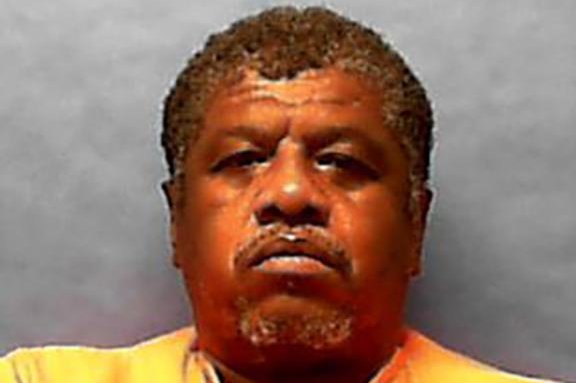
Curtis Windom, 59, was executed Thursday evening for murdering three people, including his girlfriend, on February 7, 1992. Photo courtesy of Florida Department of Corrections/Website
The state of Florida on Thursday executed a 59-year-old man for the 1992 murder of three people, including the mother of his child, despite the protestations of the victims’ families.
Curtis Windom was executed Thursday evening by lethal injection at the Florida Department of Corrections in Rainford, located about 50 miles southwest of Jacksonville. He was the 11th person put to death in the Sunshine State this year and the 30th person in the country amid a surge in executions.
He was pronounced dead at 6:17 p.m. EDT, the Florida Department of Corrections said in a statement.
On the day of his execution, Windom woke at 5 a.m., had no visitors and was not seen by a spiritual adviser, Ted Verman, the Department of Corrections’ director of communications, said to reporters during a press conference held before the execution.
His last meal consisted of ribs, baked beans, collard greens, potato salad, a slice of pie, ice cream and a soda, Verman said.
Windom was killed for fatally shooting Johnnie Lee, Valerie Davis and Mary Lubin on Feb. 7, 1992, despite their families’ years of advocating against his death.
In a statement through Floridians for Alternatives to the Death Penalty, family and friends of the three victims said they had been contacted a month ago by the state of Florid, which “excitedly” asked if they wished to witness Windom’s execution.
“We said no, and that we had, in fact, spent many years advocating against the very thing we were now being asked to come and watch, we were told that there was nothing we could do to stop it from going forward,” wrote the group, which includes Windom’s daughter, whose mother and grandmother were killed by Windom.
They said that they loved and cared for Windom and that they had celebrated graduations and weddings over the phone with him over the years.
“We have brought his grandchildren to visit him at Florida State Prison. We have built connections despite the visitation glass and cell bars. We have forgiven him,” they said.
“Rest in peace, Curtis. We love you. We forgive you. We will continue to reject the labels that we were given. We are heartbroken that the state of Florida didn’t listen to our pleas. And we are committed to continuing to tell our story.”
Windom’s attorneys have filed numerous appeals over the years, including earlier this month with the Supreme Court, which the justices denied Wednesday. No reason was given.
Court documents state on the morning of Feb. 7, 1992, in Winter City, Windom learned via a phone call that Lee had won $114 at the dog track, and told the person on the other end of the line that Lee owned him $2,000. Before ending the call, Windom told the person he was speaking with, “You’re going to read about me.”
He then went to Walmart, purchased a .38-caliber revolver and a box of shells. The court states that within minutes of purchasing the weapon, he walked up to Lee’s parked car and opened fire. Lee — who was standing with two women and Jack Luckett, the man Windom had spoken to on the phone — was struck in the back. Windom then stood over Lee and shot him twice more.
Windom, according to the court documents, then ran to the apartment of his girlfriend, Davis, who was on the phone when he entered, then he shot her in the chest.
On exiting the apartment, he ran into Kenneth Williams and shot him as well in the chest at close range. Williams would survive the shooting.
The court documents then state he shot and killed Valerie’s mother, Lubin, who was in her vehicle at a stop sign. She had heard of her daughter’s shooting and rushed from work to see her.
Windom was charged with three counts of first-degree murder and one count of attempted first-degree murder. The jury recommended death, and the judge agreed with the recommendation.
The 11 executions by Florida so far this year are a record by the state since the resumption of the death penalty in 1976. The second highest was eight in 2014 and 1984, according to the Death Penalty Information Center.
The 30 executions in the United States this year comes as the Trump administration seeks to ramp up use of the death penalty.
On the first day of his second term in the White House, the New York real estate mogul signed an executive order instructing the Justice Department and Bondi to “pursue the death penalty for all crimes of a severity demanding its use,” including “a capital crime committed by an illegal alien present in this country.”
In May, the Justice Department authorized federal prosecutors to pursue capital punishment in the case and has filed a notice of intent to seek the death penalty against Jasper Reed, 27, who is accused of killing his fellow inmate while in jail.
On Tuesday, Trump called for the use of the death penalty for those convicted of murder in Washington, D.C.
Federal executions are exceedingly rare, with only 50 carried out since 1927, including 16 since the reinstatement of the federal death penalty in 1988, according to the Federal Bureau of Prisons.
Of those 16, all but three were conducted during the final six months of Trump’s first term.
The most recent federal execution: Dustin Higgs on Jan. 16, 2021, in Terre Haute, Ind., four days before Trump left office.
Attorney General Merrick Garland issued a moratorium on federal executions on July 1, 2021.
