



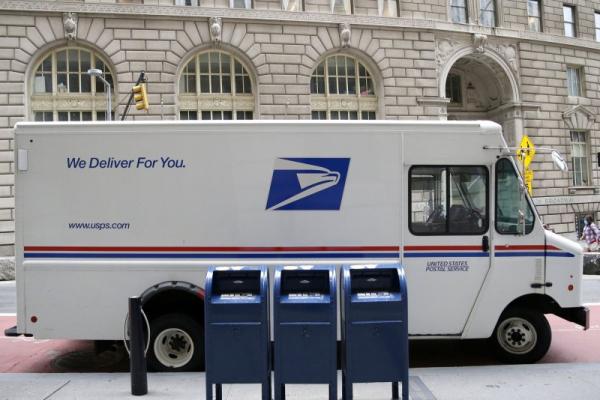
Postmaster General David Steiner confirmed the federal government, through the U.S. Postal Service, will provide states with information on who is an eligible voter and then refuse to mail ballots to those it deems ineligible. File Photo by John Angelillo/UPI | License Photo
A federal judge barred the U.S. Postal Service from refusing to mail ballots in states that haven’t turned over their registered voter rolls, one day after the postmaster general testified before a Senate committee.
The Postal Service doesn’t have the constitutional authority to administer elections and hasn’t been given the power by Congress to create binding regulations on voting by mail, U.S. District Judge Indira Talwani said in the decision.
The proposed rule said that states would have to give the Postal Service the names, addresses and ballot barcode numbers for the people who are to get ballots in the mail. The proposal follows President Donald Trump’s executive order from March 31 that requires the federal government to compile state citizenship lists and for the Postal Service to refuse to mail ballots to those the federal government has determined are ineligible to vote.
Talwani also said the timing of the executive order made it impossible for the Postal Service to propose the rule through the proper channels. It offers “no allowance for Congress’ mandated procedure regarding USPS rulemaking.”
There were 23 states that sued the Trump administration to block the executive order.
Abigail Jackson, a spokesperson for the White House, defended the executive order’s legality and said the administration was “confident that we will ultimately prevail” in effecting the executive order. She also mentioned the administration’s plan to pass the SAVE America Act in Congress.
“President Trump is committed to ensuring that Americans have full confidence in the administration of our elections,” The New York Times reported Jackson said.
The Democratic National Committee and some voting rights groups have challenged the executive order in another case. The judge in that case allowed the order to stand in May. But the order is now partially blocked because of Talwani’s decision.
Postmaster General David Steiner told the Homeland Security and Governmental Affairs Committee about the proposed rule on Wednesday.
“Yes or no — if a state refuses to turn their absentee voter list over to the federal government, will the Postal Service still mail their ballots under this proposed rule?” Sen. Gary Peters, D-Mich., asked Steiner.
“Under our proposed regulation, no. We would tell the state that we need the manifest,” Steiner said.
Steiner said the policy is to make sure ballots are delivered “securely, efficiently, and accurately.” Trump has demanded states’ voter lists over the past year and has been suing states to get them.
The proposed rule is posted on the Federal Register, and the public can comment until July 2.
Democrats have pushed back, saying the rule shows that Trump is trying to federalize elections and said the Postal Service doesn’t have the authority to enforce that rule. The Constitution says states are responsible for running elections.
“Just because President Trump wants to do this does not make it law, doesn’t make it right, doesn’t make it constitutional. There is certainly a massive difference between general mail requirements and regulating elections,” Peters said.
Steiner said that his agency doesn’t have the authority to enforce elections but said the rule is a precaution to be sure that only eligible voters will get ballots.
“I would think that states would want the information to ensure that the ballots that they think they’re sending out are the ballots that are actually getting sent out,” Steiner said.
Sen. Elissa Slotkin, D-Mich., said the rule is part of a broader strategy.
“The U.S. Postal Service is now part of this bigger story of this president desperate to federalize our elections. He has tried every which way to say that if he and his party don’t win in these November elections, they were rigged.”
Slotkin asked Steiner directly to stop the plan.
“Please push back on being a pawn in this authoritarian playbook,” she said. “The Postal Service is one of the most important institutions in our country. Don’t taint it with the obsession of this one man.”
This week in Washington
President Donald Trump presents a Medal of Honor to Tom Ripley on behalf of his father, John W. Ripley, during a Medal of Honor award ceremony in the East Room of the White House on Thursday. Photo by Aaron Schwartz/UPI | License Photo
