



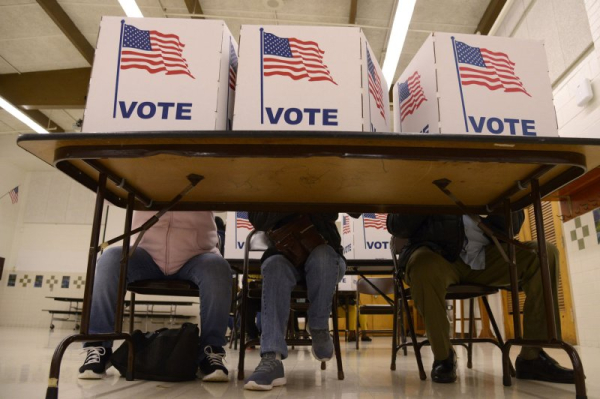
The Supreme Court’s decision in Louisiana vs. Callais has set off a series of state-level moves that seek to immediately reshape elections. File Photo by Mike Theiler/UPI | License Photo
The U.S. Supreme Court’s decision in the voting rights case Louisiana vs. Callais has added a new chapter in an ongoing redistricting battle across the country.
The high court ruled on April 29 against a majority-Black congressional district in Louisiana, ordering that it was unconstitutionally drawn because race was used as a basis for redistricting. It has already set off a series of state-level moves that seek to immediately reshape elections, starting in Louisiana, where Gov. Jeff Landry suspended an election that had already begun.
The day after the ruling was handed down, Landry ordered that the state’s primary elections be suspended, despite early votes already being cast. The primary elections were scheduled for May 16.
Thousands of early votes in those primaries, as many as 45,000, will be discarded, Landry said.
“It’s not my fault,” Landry said in an interview on 60 Minutes. “If anybody has a grievance, take it to the United States Supreme Court.”
The Louisiana assembly redrew its congressional map in 2024 in an effort to comply with Section 2 of the Voting Rights Act. The redrawn map included two majority-Black districts out of the state’s six total districts.
The plaintiffs in the Louisiana vs. Callais case challenged the new map on the grounds that it violates the Equal Protection Clause of the 14th Amendment of the U.S. Constitution because race was a key factor.
Justice Samuel Alito agreed with the plaintiffs, writing in the majority opinion in the case that the state legislature was not justified in redrawing these districts because it was compelled by race.
“Because the Voting Rights Act did not require Louisiana to create an additional majority-minority district, no compelling interest justified the State’s use of race in creating SB8, and that map is an unconstitutional gerrymander,” Justice Samuel Alito wrote in the majority opinion. “Louisiana’s enactment of SB8 triggered strict scrutiny because the State’s underlying goal was racial.
The Supreme Court’s ruling will make it more difficult for racial minorities to challenge congressional maps in court that were drawn to dilute their electoral power by raising the bar for proving racial gerrymandering took place.
As part of this, it weakened the effects test that was the standard for determining if a law would have the effect of racial discrimination. If it did, it would be in violation of the Voting Rights Act, regardless of the intent. This is no longer the case.
The decision weakened Section 2 of the Voting Rights Act of 1965 by requiring evidentiary proof of intentional discrimination, but liberal Justice Elena Kagan said it encourages states to “announce a partisan gerrymander” as a way to shield from litigation.
“Assuming the State has left behind non-smoking-gun evidence of a race-based motive [an almost fanciful prospect], Section 2 will play no role,” Kagan wrote in her dissenting opinion. “Whatever — results from the State’s asserted justification is all its minority citizens are entitled to. Even if the State has deprived those citizens [but not their majority neighbors] of all opportunity to ‘elect representatives of their choice’ the law will not protect them.”
The purpose of the Voting Rights Act, in effect, was to make good on the promise of the 15th Amendment of the Constitution to ensure that a person’s vote cannot be denied on account of their race.
The response to the Callais decision has been swift, Rebekah Caruthers, president and CEO of the Fair Elections Center, told UPI.
“We’ve seen a race across the South to make changes — and it appears these changes will disproportionately impact Black voters across the South,” Caruthers said.
Several states were already in the midst of partisan gerrymandering plans before the decision came down as part of an arms race between Democrats and Republicans vying for control in Congress this November. Both parties have been clear that their goals are to capture seats in Congress but the redrawn maps will also have implications on how racial minorities are represented, or not represented.
The effects of the decision will be felt as soon as the midterm elections in November, Caruthers said.
“The picture that we’re seeing in voting this year is districts are different, so we know that there’s going to be less opportunities for people of color to get the candidate of their choice,” she said. “We know that there’s stricter identification laws when it comes to registering to vote, even though you’re duly registered. There are still potential changes to what vote by mail looks like this year. So that is the world in which Americans, by the millions, will be heading into the elections this fall.”
The Public Interest Legal Foundation is the first organization to file a lawsuit after the Callais decision, challenging a state’s voting rights laws. It filed a lawsuit last week against the state of Illinois challenging the Voting Rights Act of 2011, arguing that it “ensures redistricting plans are crafted in a way that preserves clusters of minority voters.”
“States may not use race to allocate power,” J. Christian Adams, president and general counsel of the Public Interest Legal Foundation, said in a statement.
The Public Interest Legal Foundation is representing Republican Jeanne Ives in the lawsuit. She is a former state legislator and former gubernatorial candidate.
On Saturday, the Fair Elections Center and other voter advocacy organizations and faith leaders are holding a rally called “All Roads Lead to the South” in Salem and Montgomery, Ala. In support of protecting voting rights, they will march across the Edmund Pettus Bridge in Selma, Ala., to the state capitol building.
Caruthers said there will be people who marched with John Lewis on Bloody Sunday in 1965 to advocate for the voting rights of Black Americans.
“Montgomery, it’s not just symbolic. It’s where the last push for voting rights, where it was incubated and where it kicked off,” she said. “In this new push for voting rights in this county and understanding the reversion the Supreme Court has just handed to us, we’re going to go back.”
This week in Washington
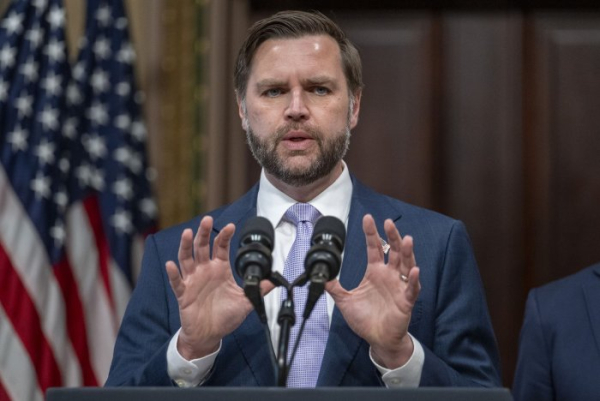
Vice President JD Vance speaks during a news conference on anti-fraud initiatives in the Indian Treaty Room of the Eisenhower Executive Office Building at the White House on Wednesday. Photo by Daniel Heuer/UPI | License Photo
