



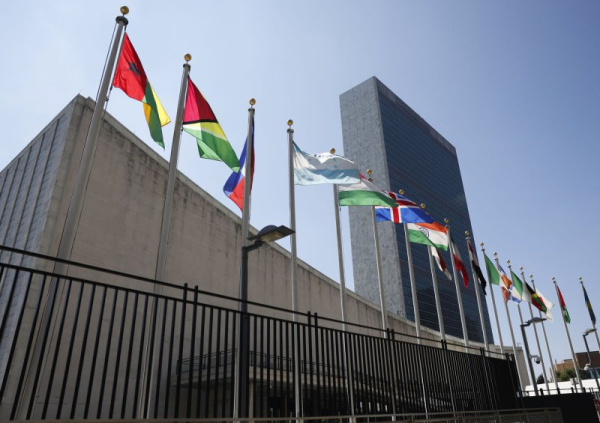
A man on Thursday died after self-immolating outside the United Nations headquarters in New York City. File Photo by John Angelillo/UPI | License Photo
A man, identified by Tibetan exile media as a Tibetan activist, died Thursday evening after setting himself on fire outside the United Nations’ headquarters in Manhattan, authorities said.
Video of the incident posted online shows the man dressed in robes and holding a Tibetan flag, which he places on a pole that keeps it erect, before he is seen flicking an apparent fire starter and becoming engulfed in flames.
Responders arrived with extinguishers more than a minute later and put out the fire. The man had crumpled to the ground.
Voice of Tibet, a Tibetan exile media outlet, identified the man as Tibetan activist Lobga Rangzen, who self-immolated after “a live appeal for Tibetan independence and unity.”
Gonpo Dhundup, a Tibetan exile parliamentarian, said in an online statement that Rangzen made “the ultimate sacrifice through self-immolation to protest China’s occupation of Tibet and its repression of the Tibetan people.”
Rangzen was taken to Bellevue Hospital, where he was pronounced dead, according to police, the New York Post reported.
UPI has contacted the New York Police Department for comment.
China has controlled Tibet since 1951 and views the region as having been an integral part of Chinese territory since ancient times. The Chinese Communist Party considers the Tibetan independence movement to be one of the so-called Five Poisons that threaten its territorial claims, along with Taiwanese independence and the Chinese democracy movement.
The International Campaign for Tibet, a Washington, D.C.-based human rights group, called Rangzen “a tireless advocate for Tibet who devoted himself to peacefully raising awareness of the human crisis in Tibet.”
The organization said in a statement that Rangzen had, in his final statement published to his Facebook account, warned that “China’s policies threaten the very survival of Tibetan identity, language and culture, and called on all Tibetans to be united in their fight for the cause of the Tibetan struggle.”
The self-immolation came two days after China’s Ethnic Unity and Progress Promotion Law went into effect, which Beijing says is designed to promote cohesion among the nation’s 56 ethnic groups.
However, human rights advocates argue that it will push ethnic groups, such as Tibetans, to adopt China’s dominant Han Chinese culture.
“‘Unity’ in this context is not harmony between different communities — it is political and ideological alignment with the Chinese Communist Party,” Amnesty International’s Deputy Regional Director Sarah Brooks said in a recent statement.
“Rather than protecting diversity and equality, the law requires conformity.”
Brooks added that the law risks providing a stronger legal basis for exercising transnational repression, specifically against those peacefully advocating for minority rights in China.
“This law puts a national legal framework behind policies that have already devastated the rights of Uyghurs, Tibetans and other non-Han ethnic groups,” she said. “We expect it to further institutionalize China’s policies of forced assimilation.”
Self-immolation is not an unprecedented form of Tibetan protest.
According to the International Campaign for Tibet, a Washington, D.C.-based human rights group, 159 Tibetans have self-immolated in Tibet, China and in exile since 2009.
This is a developing story.
