


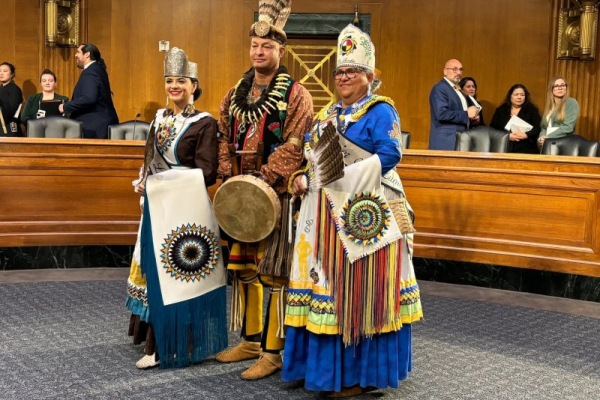
1 of 3 | Attendees gather at the end of Wednesday’s Senate Committee on Indian Affairs hearing that discussed the Lumbee Fairness Act on Capitol Hill in Washington on Wednesday. Photo by Bridget Erin Craig/UPI
The Senate Committee on Indian Affairs is considering extending federal recognition to the Lumbee Tribe of North Carolina, whose members have been denied access to federal benefits and services.
Senate Bill 107, known as the Lumbee Fairness Act, would ensure eligible members of the Lumbee Tribe receive all the entitlements provided to other tribes that are federally recognized, reversing provisions of the 69-year-old Lumbee Act of 1956.
In 1956, President Dwight D. Eisenhower signed the act, Public Law 84-570, which recognized the Lumbee Tribe of North Carolina as an Indian tribe, but explicitly denied members access to those benefits and services.
That excludes coverage from the Indian Health Service and Bureau of Indian Affairs. And without federal recognition, the Lumbee do not have the right to self-govern or receive federal funding for programs related to clean water, education and infrastructure.
Chairman Lisa Murkowski, R-Alaska, detailed the impact the Fairness Act would have on the Lumbee Tribe during an Indian Affairs committee hearing Wednesday.
“It affirms the important elements of tribal sovereignty, the ability to govern their own affairs, to tax, to establish a tribal court system and to exercise limited immunity from certain state and local laws,” Murkowski said.
“Federal recognition can also open the door to specific economic opportunities, including the ability to conduct gaming under the Indian Gaming Regulatory Act.”
The Lumbee Tribe is the largest American-Indian tribe east of the Mississippi with more than 55,000 members. A majority of members reside in Robeson, Hoke, Cumberland and Scotland counties, and North Carolina has recognized the tribe since 1885.
After it was recognized, the tribe established and operated its own school district, according to John Lowery, chairman of the Lumbee Tribe.
“In the absence of federal funding, tribal members pooled their resources and built their own Indian normal school to train Lumbee teachers for our Lumbee-run school system. The Indian normal school evolved over time and eventually became the University of North Carolina at Pembroke,” Lowery said.
Since the Lumbee Act was signed in 1956, Congress has considered more than 50 pieces of legislation and amendments to federally recognize the tribe, yet none has passed.
According to Arlinda Locklear, a Tribal attorney, the main issue that caused legislation to fail was the language of the Supreme Court.
“The court has also repeatedly acknowledged that Congress has authority to decide whether a group of Indians constitutes an Indian tribe, as long as the group is a “distinctly Indian community,” she said.
“The congressional record on the Lumbee Tribe shows that the Tribe exhibits all three components of an Indian tribe,” Locklear said. But political, fiscal and procedural concerns prevented passage, leaving the tribe in a state of partial recognition despite meeting the legal standards, she said.
The House of Representatives passed the Lumbee Fairness Act 311-96 in 2024. Before it could pass in the Senate, the 118th Congress session ended. The Senate version seems to have bipartisan support.
“This issue has come before Congress many times over the decades, but never with this level of unity and support. These days, it’s rare to see Republicans and Democrats come together on anything, but when it comes to Lumbee recognition, the support is overwhelming and it’s bipartisan,” said Sen. Markwayne Mullin, R-Okla.
In January, President Donald Trump sent a memorandum to Secretary of the Interior Doug Burgum detailing his support for federally recognizing the Lumbee Tribe and urging legislative action.
According to Murkowski, Department of Interior officials declined to testify at Wednesday’s hearing because of the government shutdown, but submitted a written testimony and promised the department would be “ensuring effective implementation of the bill.”
