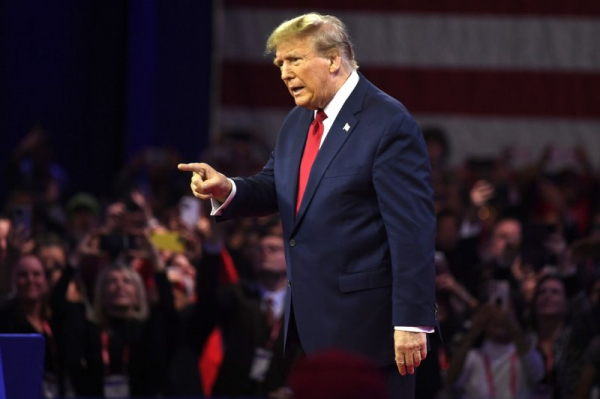


Former President Donald Trump arrives at CPAC on February 24 in National Harbor, Md. Photo by Mike Theiler/UPI | License Photo
The U.S. Supreme Court ruled Monday that former President Donald Trump can appear on the ballot, reversing a ruling by the Colorado Supreme Court.
The ruling will likely quash efforts to block Trump from the ballot across the country. Advertisement
The case came before the high court after the Colorado Supreme Court ruled that Trump is ineligible to appear on the state’s ballot. It ruled 4 to 3 that Trump engaged in insurrection, disqualifying him under Section 3 of the 14th Amendment to the U.S. Constitution.
The U.S. Supreme Court held a hearing on the case last month.
Section 3 bars anyone who participated in or aided in an insurrection from holding office. It was used to block members of the Confederacy from holding office after the Civil War.
The case was brought to the Colorado court system by a group of six Republican and unaffiliated voters. They were represented by Citizens for Responsibility and Ethics in Washington.
A lower court judge in Colorado ruled that it would not block Trump from the ballot, while also finding that he did engage in insurrection and incited the riot at the U.S. Capitol on Jan. 6, 2021. Advertisement
Trump’s defense team argued that because the language of Section 3 does not include the office of president among those listed, it does not apply to the presidency. It also refuted states’ ability to disqualify presidential candidates, arguing that only Congress has this power.
The defense also objected to the ruling that he engaged in insurrection.
Colorado is one of several states to hear arguments over Trump’s ballot eligibility. A Michigan appeals court ruled he can remain on the ballot, while the Minnesota Supreme Court dismissed a lawsuit seeking to block him. Illinois and Massachusetts dismissed lawsuits against Trump and the Maine Judicial Supreme Court rejected an appeal to remove him.
Under Section 3, Congress can grant a person amnesty, removing their disqualification, by a two-thirds vote by the House and Senate.
