



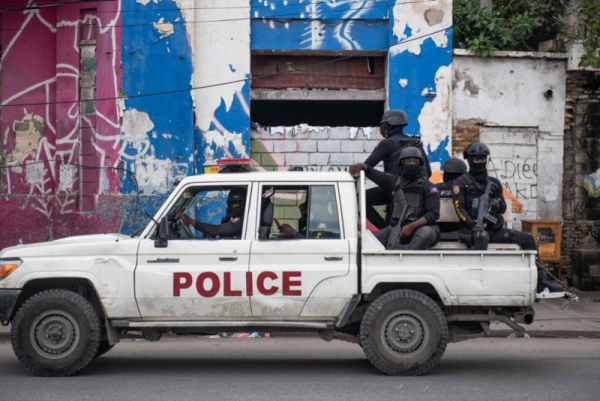
Police officers patrol a street after an attack on a public hospital in Port-au-Prince, Haiti, in 2024. Armed individuals belonging to the Vivre Ensemble coalition attacked Port-au-Prince’s General Hospital, killing at least two journalists and a policeman. File Photo by Johnson Sabin/EPA
The U.S. Supreme Court Thursday ruled in favor of the Trump administration’s plan to end protection status for Haitian and Syrian asylum seekers in the United States.
The court ruled 6-3 along ideological lines to allow the administration to remove Temporary Protected Status from about 350,000 Haitians and 6,000 Syrians.
Conservative Justice Samuel Alito wrote the decision for the majority. He said that lower-court judges who ruled against the administration had overstepped their authority. He also said that choosing to remove TPS status from Haitians was not racial discrimination.
The law “expressly restricts” courts from reviewing decisions made by the Department of Homeland Security on whether to end or extend TPS protections, he wrote. Alito also wrote that none of the things that President Donald Trump said, which plaintiffs had cited, were “overtly racial” and that argument is “insufficient to show that the termination of Haiti’s TPS designation was based on the race of the Haitian people.”
Justice Elena Kagan wrote the dissenting opinion, quoting Trump’s statements about Haitians.
“The statements fairly shout, in their racial undertones and overtones alike, that race entered into the president’s resolve to remove Haitians from this country,” she wrote.
Trump said during his campaign that Haitian immigrants were eating people’s pets.
The NAACP condemned the ruling, calling it racist.
“This ruling is a devastating betrayal of Haitian families who have lived, worked, and contributed to this country for years – only to be cast out based on anti-Black immigration sentiment,” Derrick Johnson, president and CEO of the NAACP, said in a statement. “It’s a shame that this is the America we’ve come to be.”
“The racial motivation that animated this administration’s callous decision to terminate TPS for Haitian nationals in our country is simply undeniable,” said Kristen Clarke, NAACP general counsel in a statement. “This decision flies in the face of the 14th Amendment of the Constitution, which prohibits intentional acts of racial discrimination. At every turn, we see this administration undertaking policy motivated by a toxic combination of racism and xenophobia, intended to dehumanize, diminish, and erase Black people’s presence, our political power and our voice.”
Krish O’Mara Vignarajah, president and CEO of Global Refuge, said “this is a deeply painful day for hundreds of thousands of families who have built their lives here lawfully, paid taxes, cared for our communities, and who now face the prospect of losing everything.”
“Importantly, the Court did not find that Haiti or Syria is safe. It found that the question is beyond the reach of judicial review,” she said. “Our immediate concern is what happens to these families and children should they be forced back to the dire circumstances that have long prevented their safe return. However, the larger question is whether there remains any meaningful oversight when decisions of this magnitude are made without an honest accounting of conditions on the ground.”
TPS has been in place since 1990 and offers humanitarian relief to those fleeing from war-torn countries. Those with TPS status can stay and work for 18 months, with extension possible.
Former Secretary of Homeland Security Kristi Noem decided that Haiti and Syria are no longer eligible for TPS because conditions there had improved. But the U.S. Department of State still lists both countries on its “do not travel” list.
“Haiti has been under a State of Emergency since March 2024. Crimes involving firearms are common in Haiti. They include robbery, carjackings, sexual assault and kidnappings for ransom,” the State Department says about Haiti on its website. It also says that “no part of Syria is safe from violence.”
