


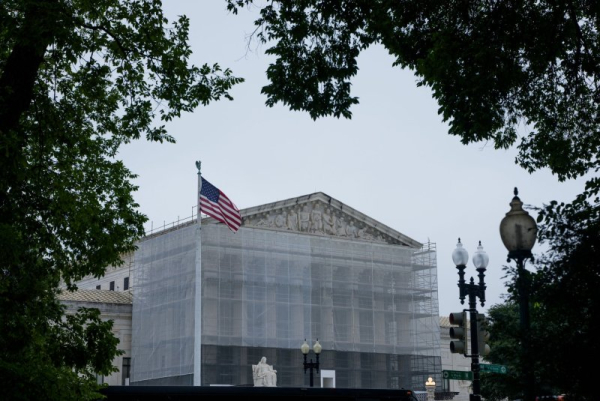
1 of 2 | The Supreme Court will hear arguments Wednesday in a case challenging President Donald Trump’s use of the IEEPA to impose tariffs. File Photo by Aaron Schwartz/UPI | License Photo
The Supreme Court is set to hear arguments this week on President Donald Trump’s authority to impose sweeping tariffs, which are typically decided upon by Congress.
The case goes to the high court on Wednesday after justices granted it an expedited review in September. Educational toy manufacturer Learning Resources Inc. filed the lawsuit in April, accusing Trump of misusing the International Emergency Economic Powers Act.
Trump, in April, imposed 10% tariffs on nearly all imported goods from nearly all countries along with higher tariffs on specific goods and countries. He said he invoked the IEEPA to counteract what he said were negative trade imbalances.
Learning Resources Inc., in its lawsuit, said Congress has the constitutional authority to impose tariffs and argued Trump misused the IEEPA. The Illinois-based company said the tariffs have eaten away at its profits, forcing it to lay off employees and increase prices.
The act allows the president to use executive authority to implement sanctions on foreign terrorists and hostile nations representing a threat to the United States. The word “tariff” isn’t used in the 1970s-era law.
“The statute does not mention tariffs or duties, and in the five decades and eight administrations since its enactment, no president besides President Trump has ever invoked IEEPA to impose a tariff or a duty,” the lawsuit says.
Tara Leigh Grove, a University of Texas at Austin professor of law, told The New York Times that the IEEPA appears to give the president a lot of leeway in its use, however the Supreme Court may not be convinced that trade deficits constitute a an emergency.
“The justices will be struggling with whether they want to second-guess any presidential decision about an emergency,” she said.
A small, family-run wine company, VOS Selections, also sued Trump over his use of tariffs, but larger corporations have stayed out of the legal fight. Multiple people involved in the case and experts told CNN it’s likely the bigger companies were worried about retribution from the president.
Gregory Shaffer, a professor at Georgetown University Law Center, said some companies are trying “to be more careful with this administration.”
“The federal government has immense leverage and immense power and can upend your business with a tweet or a tax investigation,” he said.
