



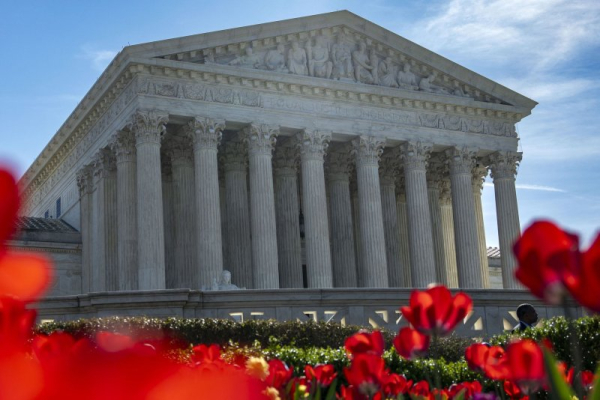
The Supreme Court threw out the conviction and death penalty for a Mississippi man because of racial bias in jury selection. File Photo by Bonnie Cash/UPI | License Photo
The U.S. Supreme Court agreed with a lower court’s ruling that a Mississippi man’s conviction and death penalty must be overturned because of racial bias in jury selection.
In a 5-4 vote, the court found that Terry Pitchford, who is Black, didn’t get a chance to challenge the dismissal of four Black potential jurors.
Pitchford was an alleged accomplice to Eric Bullins, who shot and killed store owner Reuben Britt during a robbery in 2004. Bullins wasn’t eligible for the death penalty because he was only 16 at the time. He pleaded guilty and was sentenced to 20 years. Pitchford was armed with a gun full of pellets meant to kill rats. He said he didn’t shoot Britt but instead shot into the floor.
Justice Brett Kavanaugh wrote the majority opinion in Pitchford vs. Cain, and was joined in the majority by Chief Justice John Roberts and the liberal justices. Justices Clarence Thomas, Neil Gorsuch and Amy Coney Barrett dissented.
In Pitchford’s trial, only one of the jurors was Black in a county that was 40% Black. Pitchford argued that prosecutor Doug Evans chose the jury. Evans, who is now retired, had a history of working to keep Black people off of juries.
In 2019, the Court threw out the conviction of Curtis Flowers, a Black man from Mississippi, who had also been prosecuted by Evans. The courts tried Flowers six times. The Supreme Court ruled 7-2 that Evans had pushed to keep Black people off the jury, The Washington Post reported. Flowers spent 23 years in prison.
Court records in the Pitchford case showed that Evans had written “W” or “B” next to jurors’ names in his notes.
“In this case, whether due to confusion, oversight, an overly hurried jury selection process or some other cause, things broke down, and the ordinary trial-court procedure for resolving Batson claims at step three never occurred – notwithstanding the repeated efforts of Pitchford’s counsel to pursue and preserve the Batson objection,” Kavanaugh wrote in the majority’s opinion. Batson vs. Kentucky is a case that created a process for identifying racial bias in jury selection.
Gorsuch wrote in the dissenting opinion: “Put simply, Mr. Pitchford’s account of a muzzled defense team is hard to square with the record. But even if it were a plausible account, that still would not be enough.” He was joined in the decision by Thomas, Alito and Barrett.
