


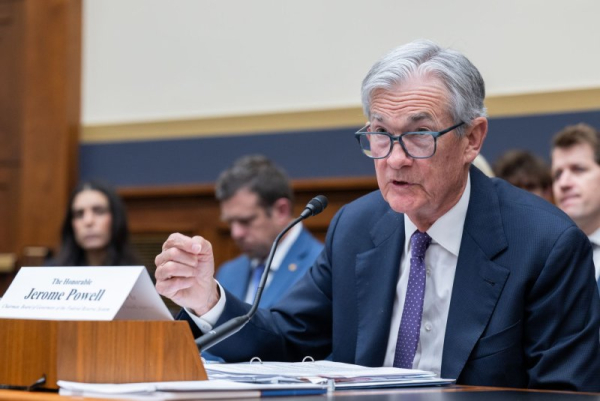
Federal Reserve Chair Jerome Powell testifies at a House hearing in Washington, D.C., in February. “If the economy remains strong, and inflation does not continue to move sustainably toward 2%, we can maintain policy restraint for longer,” Powell said Wednesday. File Photo by Annabelle Gordon/UPI | License Photo
The 99% chance the U.S. Federal Reserve was going to hold interest rates steady as recession fears rose became a certainty.
“If the economy remains strong, and inflation does not continue to move sustainably toward 2%, we can maintain policy restraint for longer,” Fed Chair Jerome Powell said Wednesday. Advertisement
The Fed’s Open Market Committee kept its borrowing rate targeted in the range of 4.25%-4.5% since about December. Fed officials added another half percentage point cut could be seen through the year.
“If the labor market were to weaken unexpectedly, or inflation were to fall more quickly than anticipated, we can ease policy accordingly,” added Powell.
Meanwhile, Trump administration tariffs on its allies such as Mexico, Canada, the European Union and China set off a response of retaliatory tariffs on steel and aluminum from both the EU and Canada and threw an economic wrench in the U.S. economy. China, meanwhile, has also retaliated with higher tariffs against American goods as consumer prices continue to rise in the United States. Advertisement
“It can be the case that it’s appropriate sometimes to look through inflation if it’s going to go away quickly without action by us — if it’s transitory,” the Fed chair pointed out. “And that can be the case in the case of tariff inflation. I think that would depend on the tariff inflation moving through fairly quickly.”
The CME Group’s Fed Watch tool that tracks target interest rate probabilities among interest rate traders showed a 99% probability of no interest rate change.
Tariffs created a heavy loss week for stocks last week with the Dow Jones Industrial Average seeing its steepest one-week decline since March 2023.
The S&P 500 finished last week 10% down, officially in correction territory.
“I think it may be one or zero cuts this year, particularly if the tariffs stick. I don’t think they’re going to try and bail out the economy by cutting rates, because they know that if they stoke inflation, they’re going to have to go back and start all over again,” Allianz Trade North America senior economist Dan Smith said.
On Feb. 11, Powell said on Capitol Hill that the Fed was in “no hurry” to change interest rates. Advertisement
Powell said the economy remained strong and with interest rate policy already “significantly less restrictive” there need be no hurry on rate adjustments.
However, the stock market plummeted on March 10, just a day after President Donald Trump said during an interview that the United States could face a recession.
Treasury Secretary Scott Bessent added to the recession fears on March 10 when he said he could not guarantee that the U.S. would not go into recession.
Twenty-three Nobel prize-winning economists saw this coming when they signed a letter in October, 2024 that said Trump economic policies would be inflationary.
They said economic policies advocated by Vice President Kamala Harris would result in stronger economic performance.
Trump polices “including high tariffs even on goods from our friends and allies and regressive tax cuts for corporations and individuals, will lead to higher prices, larger deficits, and greater inequality,” the economists wrote.
