


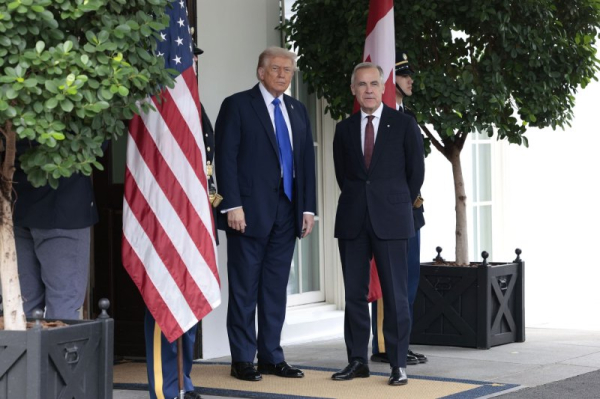
US President Donald Trump (L) welcomes Canadian Prime Minister Mark Carney (R) to the White House in Washington, D.C., on October 7, 2025. On Monday, Trump threatened to block the opening of a new Canada-U.S. bridge amid fracturing relations between Washington and Ottawa. File Photo by Shawn Thew/UPI | License Photo
President Donald Trump is threatening to block the opening of a Canada-funded bridge linking Ontario with Michigan, saying the United States must be “fully compensated for everything we have given them.”
Trump issued the threat via his Truth Social platform on Monday evening, targeting the long-planned, $4.4 billion Gordie Howe International Bridge, which is expected to open later this year along the Windsor-Detroit Gateway, the busiest commercial land border between the two countries and a critical North American auto manufacturing artery.
“I will not allow this bridge to open until the United States is fully compensated for everything we have given them, and also, importantly, Canada treats the United States with the Fairness and Respect that we deserve,” he said, declaring that unspecified negotiations would start “IMMEDIATELY.”
It was unclear what compensation Trump was seeking from Canada or what legal authority he would have to block the opening of the Ottawa-financed bridge.
The threat follows repeated criticism by Trump of Canada’s effort to deepen economic ties with China as it seeks to lessen its dependency on the United States amid their fracturing relationship.
Trump warned Monday that China “will eat Canada alive.”
“We’ll just get the leftovers,” he said. “I don’t think so.”
Trump framed the bridge as an attempt by Canada to “take advantage” of the United States, despite having approved the project during his first administration. In February 2017 joint statement with then-Canadian Prime Minister Justin Trudeau, Trump said the bridge “will serve as a vital economic link between our two countries.”
In 2012, Michigan’s then-Republican governor, Rick Snyder, agreed to the six-lane, 1.5-mile bridge, which is expected to alleviate congestion, accommodate future travel and create new transportation capability amid the two countries’ manufacturing regions.
Sen. Elissa Slotkin, D-Mich., said Trump’s threat against the bridge will be “awful” for Michigan’s economy.”
Higher costs for Michigan businesses, less secure supply chains and fewer jobs were among the “serious repercussions” that will result from blocking the bridge, she said in a statement.
“With this threat, the President is punishing Michiganders for a trade war he started,” she said.
“The only reason Canada is on the verge of a trade deal with China is because President Trump has kicked them in the teeth for a year.”
Ottawa and Beijing are in negotiations on a new trade deal, with Canadian Prime Minister Mark Carney announcing last month that they have come to consensus of series trade issues, including opening Canada’s market to Chinese-made electric vehicles.
Canada has turned to China, as well as Europe, to lessen its dependency upon the United States amid instability in their partnership.
Trump’s imposition of tariffs on Canada, the shift of the United States from multilateralism under his helm and his bellicose rhetoric that includes threats to make its northern neighbor the 51st state, have drawn anger from Ottawa and a recalculation of their relationship.
Carney has described Trump’s actions as a “betrayal,” stating Ottawa could no longer depend on Washington due to the fundamental shift their relationship is undergoing.
In response to the tariffs and Trump’s comments, U.S.-made alcohol has been pulled from many Canadian shelves, many Canadians are boycotting U.S.-made goods and fewer of them are traveling south of their shared border.
“We cannot forget Canada is our friend and ally,” Rep. Debbie Dingell, D-Mich., said in a statement in response to Trump.
“We have to stop these cheap shots. It helps no one, and it especially hurts our economy.”
