



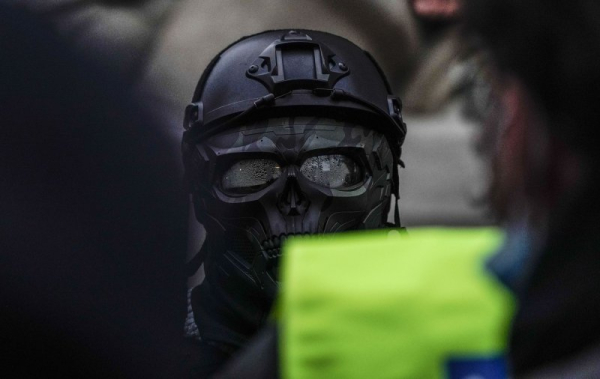
1 of 5 | Proud Boys and pro-Trump supporters gather and march to protest against the Electoral College vote count that would certify President-elect Joe Biden as the winner in Washington, D.C., on Jan. 6, 2021. File Photo by Leigh Vogel/UPI | License Photo
In little more than a week since the Trump administration announced the creation of a nearly $1.8 billion Anti-Weaponization Fund, lawsuits have been filed to block it from paying out to Jan. 6 rioters.
The Public Integrity Project was the first to file a lawsuit to block the fund last week. Democracy Forward, a nonprofit organization in Washington, D.C., also filed a lawsuit on Friday. Both groups allege that the Anti-Weaponization Fund is a “slush fund.”
Brendan Ballou, founder of the Public Integrity Project, told UPI that the basis for establishing the fund stands on shaky legal ground. Ballou is a former special counsel in the U.S. Department of Justice’s Antitrust Division.
The fund, announced by the Department of Justice and acting Attorney General Todd Blanche last week, is to be filled by the U.S. Department of the Treasury to pay out as a settlement agreement to be paid to “victims of lawfare and weaponization.”
“The basic concern that we have is for the Department of Justice to settle a case, there actually needs to be a case,” Ballou said. “You need actual adversity, which does not seem to be the case here. So the initial problem that you have with the memo is that it’s settling a lawsuit that functionally cannot exist.”
President Donald Trump ordered the creation of the fund as part of a settlement to drop his $10 billion lawsuit against the Internal Revenue Service. Trump and his sons Donald Jr. and Eric sued the IRS for allegedly leaking Trump’s tax returns during his first term as president.
The fund is to be filled by the U.S. Treasury Department, via tax dollars, within 60 days.
“We have repeatedly stated that anyone who feels they were a victim of lawfare can submit a claim,” a Department of Justice spokesperson told UPI. “Who receives money and how much they receive is up to the commission to decide, but for now those are hypothetical questions.”
The Public Integrity Project says in its lawsuit that the fund’s creation violates the 14th Amendment of the Constitution by using federal money to pay debts or obligations “incurred in aid of insurrection or rebellion against the United States.
Two law enforcement officers who defended the U.S. Capitol, Metropolitan Police officer Daniel Hodges and U.S. Capitol Police officer Harry Dunn, are plaintiffs in that lawsuit.
“Ultimately we’re bringing this case because this fund is going to be used to fund the very rioters and paramilitary groups that threatened our clients and that threatened the lives of our clients and continue to do so,” Ballou said. “Officers Hodges and Dunn defended the Capitol on Jan. 6, almost potentially died that day. They continue to receive credible death threats from rioters or their supporters.”
Democracy Forward’s lawsuit similarly challenges the creation of the fund, alleging that it “exceeds executive authority, unlawfully bypasses Congress’s exclusive authority over federal spending and appropriations and violates the Administrative Procedure Act.”
The Administrative Procedure Act is a federal law that establishes how federal administrative agencies can make rules. It also directs how they may adjudicate administrative litigation, resolving disputes between parties.
The Anti-Weaponization Fund allegedly violates the Administrative Procedure Act by circumventing congressional authority over federal spending and appropriations and explicitly avoiding oversight mechanisms. It also does not include any judicial review and lacks details about who can make claims to receive funds, how they will receive those funds and how the amount they receive will be determined.
“What we’re seeing is, in so many avenues, just an astounding, almost unthinkable level of corruption in the United States,” Ballou said. “The goal of our law firm is to raise the legal and reputational cost of corruption in America. This is one fight we’re bringing. We certainly think that this is perhaps the largest single instance of corruption in America this century. But this is a multi-pronged issue dealing not just with this particular administration but with massive corruption occurring throughout the government.”
The Trump administration has been accused of violating the Administrative Procedure Act in other instances, including its attempt to make changes to FEMA grant policy, Environmental Protection Agency grant policy and his decision to change the name of the John F. Kennedy Center for the Performing Arts.
Plaintiffs in the Democracy Forward lawsuit include former Assistant U.S. Attorney and Jan. 6 prosecutor Andrew Floyd and the National Abortion Federation.
“First, hundreds of people attacked the foundation of an ordered society by trying to stop the results of a free and fair election — committing serious assaults on law enforcement and other crimes as they did so,” Floyd said in a statement.
“Then this administration pardoned them — removing the accountability that had been hard earned by victims, witnesses, law enforcement and prosecutors and imposed by imperial jurors and judges. Now they are asking taxpayers to illegally reward them for their crimes.”
This week in Washington
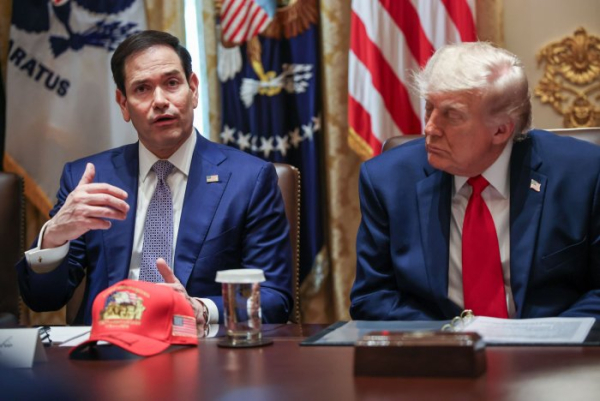
Secretary of State Marco Rubio and President Donald Trump participate in a Cabinet meeting in the Cabinet Room of the White House on Wednesday. Photo by Samuel Corum/UPI | License Photo
