


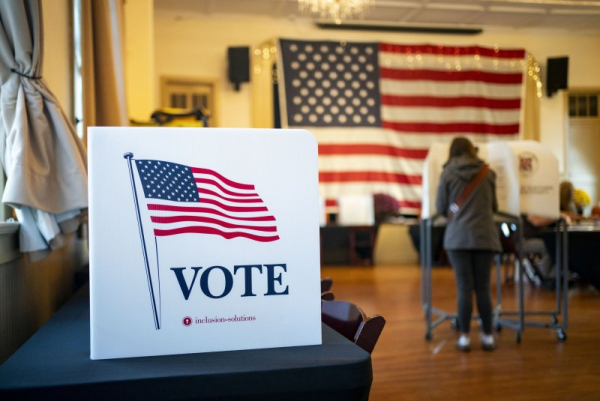
1 of 2 | President Donald Trump is pursuing a proof of citizenship requirement for voting in federal elections, both with an executive order and the Safeguard American Voter Eligibility Act that is being mulled by U.S. Congress. File Photo by Bonnie Cash/UPI | License Photo
President Donald Trump’s multipronged plan for ensuring only eligible citizens vote in elections leans on a system that experts say is flawed.
Trump’s executive order announced last week directs election officials to use Social Security Administration records and the Department of Homeland Security’s Systematic Alien Verification for Entitlements, or SAVE system, to assist in verifying voter eligibility.
However, the Social Security Administration’s records, by its own admission, cannot reliably verify citizenship and the SAVE system has a history of misidentifying citizens as noncitizens.
The president is meanwhile urging Congress to pass the Safeguard American Voter Eligibility Act or SAVE Act — not to be confused with the aforementioned SAVE system — which would direct election officials to use the SAVE system and Social Security records to verify citizenship.
A U.S. Citizenship and Immigration Services spokesperson told UPI in a statement that the SAVE system has identified more than 21,000 cases of potential noncitizens being included on voter rolls.
“Those cases have been referred to [Immigration and Custom Enforcement’s] Homeland Security Investigations for further investigation,” Matthew J. Tragesser, USCIS spokesman, told UPI in a statement.
“Over the past year, U.S. Citizenship and Immigration Services has overhauled the SAVE program, making it fully operational and providing states with an easy-to-use tool that has resulted in over 60 million voter verification queries processed since April 2025.”
‘It’s a fantasy’
Jon Sherman, litigation director and senior counsel at the Fair Elections Center, told UPI that the federal government does not have the tools or the capacity to accurately identify all noncitizens.
“Most people think the federal government has citizenship data and the capacity to create a national citizenship list but it’s a fantasy,” Sherman said. “There is no national citizenship list. There is no national list of noncitizens residing in the U.S. The closest we have is the SAVE system but this is not a reliable database on which you can make someone’s right to vote contingent.”
The Trump administration began overhauling the SAVE system last year by expanding its use and including more federal data. The federal government has looked to states to upload data into the system to assist in verifying citizenship.
The SAVE system was designed to verify immigration status for people applying for government benefits.
At least two dozen states have agreed to share voter data with the federal government. The Justice Department has filed lawsuits against 29 states for not complying with its request for voter roll data.
Misidentified citizens
In email exchanges between U.S. Citizenship and Immigration Services and state officials obtained by The Texas Tribune and ProPublica in February, DHS noted multiple instances across at least five states in which U.S. citizens were marked as noncitizens by the SAVE system.
In Missouri and Texas, some citizens were temporarily made ineligible to vote.
Pamela Smith, CEO and president of Verified Voting, told UPI the SAVE system’s errors were frequent enough to potentially impact some election results.
“Some researchers found that more than 5% of the voters that the SAVE database had identified as noncitizens were actually citizens,” Smith said of SAVE errors in Texas. “Five percent is a big number. That’s well over the margin of victory in lots of situations. In some of the smaller counties that percentage became much higher.”
A few factors are involved in creating these issues, including bulk uploading of voter files, outdated data and a lack of manual verification that the data provided is accurate.
Derived citizens, citizens who obtain their citizenship as minors when their parents are naturalized, have also been falsely flagged as noncitizens by the SAVE system, Sherman said.
Citizenship status is not static. Each year, as many as 800,000 people or more are naturalized, the Library of Congress reported in September. When this happens, they are not required to update their status with the Social Security Administration by filing a certificate of citizenship and do not need to immediately obtain a new driver’s license.
The filing fee for a certificate of citizenship costs $1,385.
“Even before this recent overhaul of SAVE, which enabled bulk upload and incorporated all of this unreliable data from the Social Security Administration, SAVE already had reliability and data integrity issues going back for years,” Sherman said. “It’s definitely been a rushed rollout. They’ve sort of been building the plane while flying it.”
When the Fair Elections Center subpoenaed the Social Security Administration in the 2023 case Mi Familia Vota vs. Adrian Fontes, the administration acknowledged that its records “do not provide definitive information on U.S. citizenship.” It adds that it did not begin maintaining citizenship information until 1981.
“Accordingly, SSA does not have citizenship information for all individuals who have been issued an [Social Security Number],” the administration wrote. “As such, the citizenship SSA maintains merely represents a snapshot of the individual’s citizenship status at the time of their interaction with SSA.”
Rare cases of noncitizen voting
For the states that are using the SAVE system, even if counting the errors as correctly marking noncitizens on voter rolls, the data does not support the president’s claims of widespread voting by noncitizens.
“They’ve all shown completely underwhelming numbers,” Sherman said. “The use of the SAVE system has demonstrated what voting rights advocates have said all along: vanishingly small numbers of noncitizens are on the rolls and even more vanishingly small numbers have actually managed to inadvertently cast a ballot.”
The Heritage Foundation, the nonprofit conservative organization that proposed government policies in Project 2025 and has since had dozens of members serve in the Trump administration, reported about 100 election fraud cases in which noncitizens voted between 1999 and 2024.
“You’re going to have occasional voter fraud. That happens,” Smith said. “But it’s rare and when it happens, the states prosecute and they do so successfully.”
Executive order
Trump has remained committed to seeing the SAVE Act pass in Congress. The bill would require documentary proof of citizenship to vote. Documents that serve as acceptable forms of identification include a passport, military ID or a government-issued photo ID that includes a birth place. A combination of a birth certificate, record of birth or report of birth abroad, a certificate of naturalization or certificate of citizenship may also be accepted.
The proof of citizenship requirements set a standard that Smith and other voting rights advocates fear will disenfranchise eligible voters.
The executive order issued by Trump last week also urges the Justice Department to prosecute election officials who issue ballots to noneligible voters. This includes anyone who prints, produces, ships or distributes ballots.
Citizenship is already a requirement to vote in federal elections.
Trump orders that states update and transmit a state citizenship report no fewer than 60 days before a federal election. This provision directly contradicts the National Voter Registration Act which requires states to set their voter registration deadlines no earlier than 30 days before a federal election.
Several states allow voters to register even closer to Election Day.
“Election officials are always working on maintaining clean voter rolls,” Smith said. “Election officials have various tools, which could include SAVE, for checking and confirming that voters have correct eligibility. Why not let them continue to do what they do so well?”
