



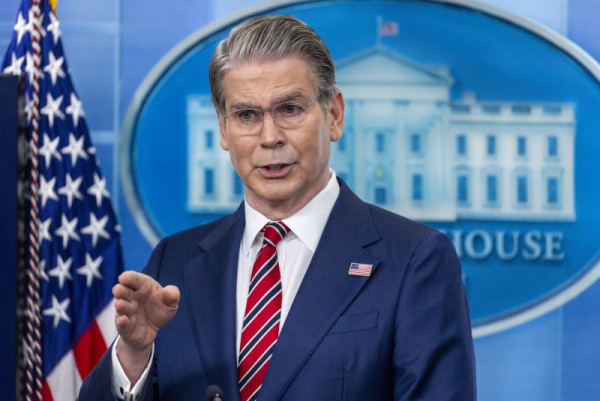
The Treasury under Secretary Scott Bessent sanctioned 35 entities and individuals accused of operating as a sanctions-evasion banking network for Iran. Photo by Shawn Thew/UPI | License Photo
The United States has sanctioned 35 entities and individuals accused of overseeing a shadow-banking network that moved tens of billions of dollars for Iran, as the Trump administration flexes Washington’s financial might amid a stalemate in peace negotiations with Tehran.
The sanctions announced Tuesday come as U.S.-Iran peace negotiations came to a halt last week after Tehran said it would not participate in talks until the United States lifted its blockade of sea-based trade to the Middle Eastern nation.
Those blacklisted by the Treasury include several private companies known as rahbars, which manage thousands of overseas companies used by Iranian banks cut off from the international financial system to execute payments for Iranian trade.
According to the Treasury, these rahbar companies coordinate with Iranian exchange houses and front companies to conduct international trade on behalf of the Islamic Revolutionary Guard Corps, Iran’s Armed Forces General Staff, the National Iranian Oil Company and other sanctioned entities.
“By dismantling these financial channels, we advance the administration’s policy in the conflict with Iran and underscore our commitment to imposing maximum pressure on Iran,” State Department spokesman Thomas Pigott said in a statement.
The punitive action was part of what the Treasury calls Operation Economic Fury, a branded escalation of President Donald Trump’s broader maximum-pressure campaign against Iran.
Coinciding with the sanctions on Tuesday, the Treasury’s Office of Foreign Assets Control issued an alert to financial institutions over the risks they face for doing business with so-called teapot oil refineries in China, primarily in Shandong Province, that import and refine Iranian crude oil.
According to the alert, China is the largest purchaser of Iranian oil, and the Treasury has designated multiple small China-based refineries since March of last year.
“The United States will further disrupt illicit funding streams that finance Iran’s malign activities,” Pigott said.
“We will not relent in our efforts to deny Iran and its proxies the resources they use to threaten U.S. interests and regional stability.”
Trump first employed the maximum-pressure campaign strategy to coerce Iran into negotiations over its nuclear program in 2018 after unilaterally withdrawing the United States from a landmark multinational accord that sought to prevent Tehran from obtaining a nuclear weapon.
Iran then breached its commitments under the deal, enriching uranium up to 60%, far exceeding the accord’s 3.67% but below weapons-grade levels.
Trump restored the maximum-pressure campaign after returning to office in 2025, and the United States bombed three major Iranian nuclear facilities that June.
The United States and Israel have since escalated their pressure campaign, attacking Iran in strikes that triggered a war now halted by a fragile cease-fire to permit peace talks.
Iran has imposed restrictions on energy trade through the Strait of Hormuz, prompting the United States to impose a blockade of Iran’s ports in response to what it describes as Tehran holding a major share of the world’s energy supplies hostage.
