



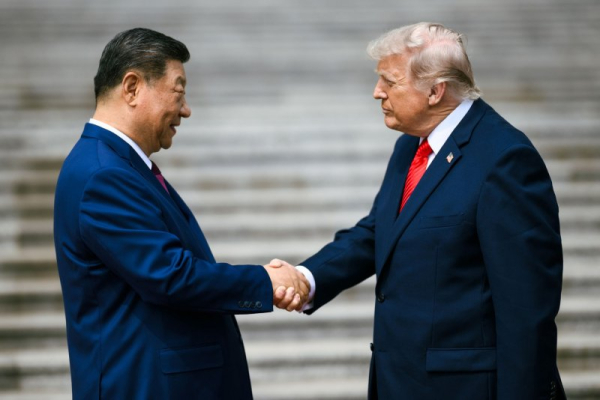
U.S. President Donald J. Trump participates in a welcome ceremony with President Xi Jinping of the People’s Republic of China, Thursday, at the Great Hall of the People in Beijing, China. Photo by Daniel Torok/The White House/UPI | License Photo
China has agreed to purchase at least $17 billion worth of U.S. agricultural products per year through 2028, the White House said Sunday as it touted agreements made during President Donald Trump’s trip to Beijing.
Trump returned to the United States on Friday following a two-day trip for meetings with Chinese leader Xi Jinping. Chinese readouts emphasized strategic stability and Taiwan, while the White House highlighted agreements on agriculture, aviation, critical minerals and trade mechanisms.
A fact sheet from the White House on Sunday said Trump had secured “historic deals” with China, with the annual $17 billion in agricultural products on top of the soybean purchase commitments Beijing agreed to last year.
China’s Commerce Ministry, however, described the agreements as being under consultation, with both sides working to finalize them.
According to the White House, China also approved an initial purchase of 200 U.S.-made Boeing aircraft for Chinese airlines, agreed to resume imports of poultry from U.S. states determined to be free of highly pathogenic avian influenza and said it would restore market access for U.S. beef.
The White House also said China “will address U.S. concerns” regarding supply chain shortages of rare earths and other critical minerals.
“President Trump negotiated a sweeping package of commitments that will drive high-paying American jobs and open new markets for U.S. goods,” the White House said.
The two countries also agreed to establish two institutions — the Board of Trade to manage bilateral trade of non-sensitive goods and the Board of Investment, a forum for investment-related issues.
China’s Ministry of Commerce said in a statement Saturday that through the trade council, the two sides will discuss issues such as tariff reductions, stating that they “agreed to reduce tariffs on products of concern to each side on an equivalent scale.”
China said it would “actively promote the resolution of U.S. concerns” regarding beef registrations and poultry exports to China in exchange for easing or resolving U.S. import restrictions on dairy and aquatic products.
“The positive results achieved in the China-U.S. economic and trade consultations show that, by upholding the spirit of mutual respect, equality and mutual benefit, the two sides can find ways to resolve problems through dialogue and cooperation,” the ministry said.
While mentioning that an agreement was reached for China to purchase planes from the United States, the ministry did not state the number of aircraft to be bought. It also did not mention rare earths and critical minerals.
As the trip came to an end on Friday, Trump told reporters in Beijing that he thought “a lot of good” came out of his visit.
“We’ve made some fantastic deals, really for both countries,” he said.
A Chinese Foreign Ministry readout from Friday stated that Trump and Xi “have agreed on a new vision of a constructive China-U.S. relationship of strategic stability.”
According to a statement from the ministry on Thursday, Xi said Beijing and Washington should implement the “important common understandings” they reached through the trip, while stressing the issue of Taiwan is not only the most important in their relationship but that it could result in clashes and potential conflicts, “putting the entire relationship in great jeopardy.”
“The U.S. side must exercise extra caution in handling the Taiwan question,” the ministry said.
China views the island of some 23 million people off its southeastern coast as a breakaway province and has vowed to take it back by force, despite Taiwan never being part of the People’s Republic of China, which was founded in 1949.
This week in Washington
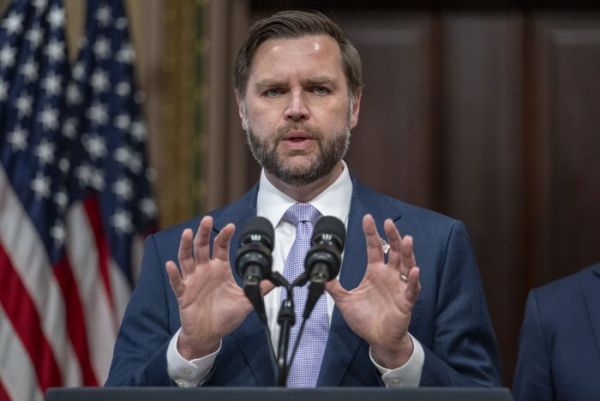
Vice President JD Vance speaks during a news conference on anti-fraud initiatives in the Indian Treaty Room of the Eisenhower Executive Office Building at the White House on Wednesday. Photo by Daniel Heuer/UPI | License Photo
