



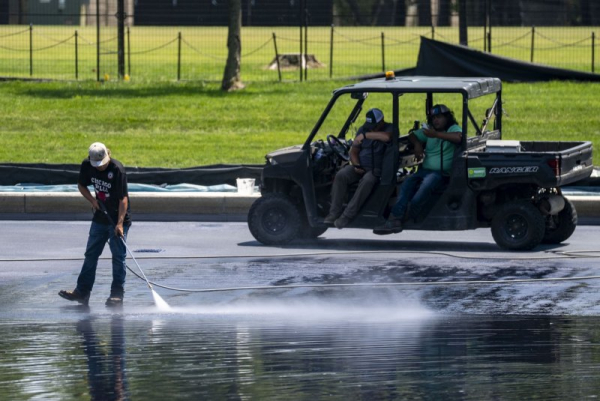
Workers pressure wash the Lincoln Memorial Reflecting Pool as it slowly fills with water in Washington, D.C., on June 5. Days after refilling the pool, algae began growing in the water. Photo by Bonnie Cash/UPI | License Photo
Just in time for America’s 250th birthday, the Lincoln Memorial Reflecting Pool received a new paint job. But days after the pool was refilled, an unwelcome green sludge began taking over the new blue surface.
Now, National Park Service crews are working to control what experts say was likely an inevitable problem: a large algae bloom on the National Mall.
University of Maryland Center for Environmental Science professor Patricia Glibert studies phytoplankton, or algae, and how nutrients such as nitrogen and phosphorus can fuel growth. She told AccuWeather that algae is a natural process and is found nearly everywhere.
“Every body of water from the smallest pond to the biggest ocean has algae,” Glibert said.
While Glibert is not an expert in still bodies of water, such as the reflecting pool, she said the same basic science applies to how algae blooms form.
In April, the pool was drained and resurfaced. In early June, crews began refilling it, likely kicking off the algae bloom visitors are seeing now.
“As the pond was refilled, it probably had residual water in some of the infrastructure, algae was probably residual in that water,” she told AccuWeather.
Another factor was the timing. The refilling process began in early June, as hot weather was building in Washington, D.C., including a high of 100 degrees on June 12.
“You put those ingredients together, and there was probably in the water coming in sufficient nitrogen or phosphorus, or both, to grow the amount of algae that we see, it takes the building block of nitrogen and phosphorus, the fertilizers to grow algae.”
On a bright, hot day, algae can grow quickly. Glibert said algae growth can double in a day, if not more than once a day. Over several days, that rapid growth can produce an algae bloom. In this case, the bloom spread across the entire reflecting pool.
The newly resurfaced dark blue bottom may have played a role by helping warm the water, Glibert said, but most of the ingredients for a bloom were likely already present.
Cleanup before the stink-up
Social media users commenting on the green sludge in the reflecting pool have offered no shortage of tips for rangers working to clean up and control the algae bloom, from chlorine and hydrogen peroxide to a better circulation system. Glibert said those are all possible solutions, but each comes with trade-offs.
Photos show National Park Service crews using water pumps and skimmers to remove algae and push it toward the aeration area at the center of the pool.
“Killing the algae is the easy part,” Glibert said, adding, “We want to be sure that we kill algae in such a way that we don’t create other problems.”
Once the algae is dead, the bigger problem is what happens next.
“The filtration system has to be able to remove that biomass otherwise, it’s dead, rotting,” she said. “Slime that then decomposes, then those nutrients come back into the water and the whole cycle starts all over again.”
Any residual dead biomass can settle as scum on the bottom of the pool, covering the new paint and potentially feeding another round of algae growth if it is not removed.
That makes the cleanup more than a cosmetic challenge. For crews trying to restore one of Washington’s most photographed views before the nation’s 250th birthday celebrations on July 4, the key will be removing the algae without leaving behind the nutrients that helped it grow in the first place.
This week in Washington

President Donald Trump speaks to reporters about restoring commercial fishing access to areas of the Pacific during a signing ceremony in the Oval Office of the White House on Thursday. Photo by Jim Lo Scalzo/UPI | License Photo
