



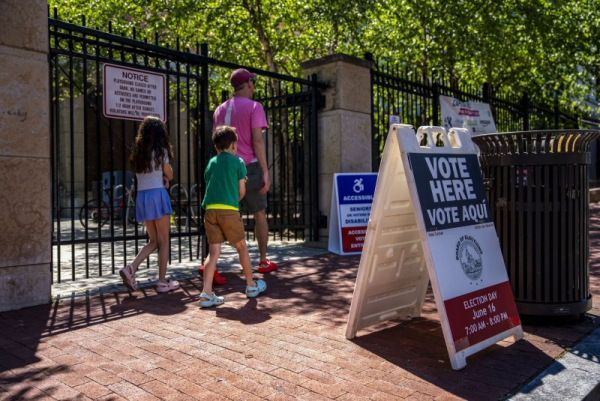
People arrive to vote in Washington, D.C.’s, 2026 primary elections at Stuart Hobson Middle School on Tuesday. The two front-runners to succeed Mayor Muriel Bowser are Kenyan McDuffie and Janeese Lewis George. Photo by Bonnie Cash/UPI | License Photo
The District of Columbia is having its first ranked-choice election, and Oklahoma is voting on whether to raise the state’s minimum wage on Tuesday.
Oklahoma is set to choose its party nominations for the state’s governor, U.S. and state lawmakers, state superintendent and attorney general. Oklahoma Gov. Kevin Stitt can’t run again because of term limits.
Oklahomans will also decide State Question 832, which would increase the state’s minimum wage to $15 per hour by 2029. It’s now at $7.25.
The Democratic primary in the state is now closed, though in the past it was open. That meant that independents could vote in the Democratic primary. Now, only Democrats can vote in the Democratic primary, KOCO-TV reported.
Since the beginning of the year, more than 17,000 Oklahomans have changed their party, and 9,000 of those were independents.
In Washington, voters will choose the D.C. delegate to Congress to replace Eleanor Holmes Norton, who isn’t seeking re-election. She has held that position since 1991.
There are three Democrats running for the seat — Kinney Zalesne, Robert White and Trent Holbrook — and one Republican, Denise Rosado, running unopposed.
D.C. Attorney General Brian Schwalb is facing a primary challenger, JP Szymkowicz.
This is also the first time Washington will use ranked-choice voting, where voters rank candidates in order of preference. If no candidate gains a majority, the counting process continues in rounds. The candidate with the fewest votes will be eliminated each round, and their votes redistributed to the others until someone crosses the 50% plus 1% threshold.
Voters had mixed feelings about ranked choice voting, WTOP-TV reported.
“It was quite confusing, frankly,” Alex Howard told the station. “The paper ballot that I received at home was very different from the electronic ballot that I used just now at the voting precinct.”
Karen Evans called the ranked choice voting experience “terrible.”
“It’s a lot of candidates on the ballot,” Evans told the station. “It makes it time consuming, and some of these candidates I’ve never even heard of.”
Harrison Kreisberg told WTOP, “I think it’s great for democracy, and I’m excited that we got it here in D.C.”
Oklahoma’s polls are open until 7 p.m. CDT, and Washington’s polls stay open until 8 p.m. EDT.
