


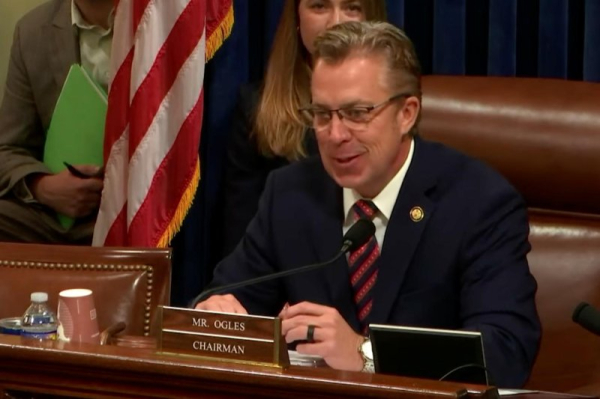
Chair Andy Ogles, R-Tenn., of the House Committee on Homeland Security Subcommittee on Transportation and Maritime Security speaks to witnesses at a hearing focused on threats to U.S. undersea cables by foreign adversaries on Capitol Hill in Washington on Thursday. Photo by Bridget Erin Craig/UPI
The United States faces growing threats to its undersea cable network that underpins global internet and financial traffic. Lawmakers and security experts pointed Thursday to recent incidents abroad as signs that foreign adversaries are testing the system’s resilience.
On Thursday, the House Committee on Homeland Security Subcommittee on Transportation and Maritime Security stressed that the United States lacks the coordination, defenses and deterrence needed to prevent or respond to deliberate attempts to disrupt these cables.
“I think an emphasis on securing these cable landing stations is of the utmost importance, because we have a lot of them, which also means we don’t necessarily have the physical security and cybersecurity mechanisms in place to safeguard each of those isolated stations,” said Kevin Frazier, artificial intelligence innovation law fellow at the University of Texas.
Officials said current policy gaps leave the network exposed to physical sabotage and more sophisticated forms of interference. Without a more seamless exchange of information, they said, the United States will remain slow to respond to suspicious activity.
“What we need is an agency that recognizes the need not just to secure a cable, but that securing all cables is what gives us national security, and that means more of a sense of urgency to assist the industry to build more protection,” said Timothy Stronge, chief research officer of TeleGeography, a telecommunications data provider and mapper.
Undersea cables are the backbone of global communications, carrying more than 95% of international internet traffic, financial transactions and government communications.
These cables are able to move vast amounts of data at high speed and low cost, essential for tasks ranging from military coordination to social media use.
The United States alone has 97 of the almost 600 cables worldwide that travel along both coasts, including sites in California, Oregon, Virginia, New Jersey and Florida.
The lines connect the country to Europe, East Asia, South America, the Caribbean and Australia, forming a dense global network. Several cables pass through strategic locations like the North Atlantic routes, Guam and Hawaii — making their security especially critical.
While companies are expected to report cable disruptions and can voluntarily share operational data with the federal government, witnesses argued that the government still struggles to detect foreign involvement, enrich the information with intelligence and quickly alert industry when a threat emerges.
“Instead of a coherent national policy, what we have is a thousand different rules. This is at a time when France has a coherent seabed strategy. Italy, Norway, the United Kingdom — even Russia does. As far as I can tell, the United States doesn’t really pursue that kind of strategy,” Stronge said.
Experts pointed to recent cable damage in Europe as a warning. Incidents involving Chinese-linked activity near the Matsu Islands and unexplained breaks in the Gulf of Finland underscored how difficult it is to determine whether a disruption is accidental or part of foreign interference.
The inability to attribute attacks, combined with weak or nonexistent consequences for suspected actors, means adversaries face little deterrent. Witnesses warned this uncertainty allows for more aggressive attempts.
Although the United States is connected by nearly 100 subsea cables placed globally, experts cautioned that this abundance also can mask vulnerabilities. Cable landing stations often are situated in isolated coastal areas with limited physical and cybersecurity protections.
“These cable landing stations are often in places like Valdez, Alaska, and Bandon Dunes — which is great for golfing if you live in Oregon — but easy to attack if you’re looking to sabotage the nation’s submarine systems,” Frazier said.
These stations then become the easiest targets for sabotage. Damage at these sites could interrupt major data routes and take weeks to repair, especially given limited repair-ship availability.
Another factor is that the area of an ocean that surrounds a country is separated into the territorial sea and the exclusive economic zone. Within the territorial sea, which can extend up to almost 14 miles from the coastline, a country has nearly total sovereignty over it.
If a country’s undersea cable is damaged within the territorial sea of a different country, it requires even further permitting to gain approval for repair.
Witnesses added that U.S. permitting delays erode the country’s strategic advantage. Lengthy approval timelines have already discouraged companies from building new cables with the United States.
This has increased the risk that future routes could shift to neighboring countries. Experts argued that this would reduce resilience and make it easier for adversaries to concentrate their efforts on weaker points in the system.
“We don’t like fragmentation in national security policy. We saw the dangers of fragmented intelligence before 9/11,” said Matthew Kroenig, senior director at the Atlantic Council’s Scowcroft Center for Strategy and Security.
“Right now, it seems like several different parts of government have some responsibility here, and making the Department of Homeland Security a coordinated hub to address this challenge could make sense,” Kroenig said.
He urged Congress to adopt a clearer national strategy by consolidating responsibility under the Department of Homeland Security and the Coast Guard, and elevate cable security as a core element of national defense.
“Congress can mandate that the executive branch develop strategies to deal with an issue, and I would recommend that you task the executive branch and the Department of Homeland Security with coming up with a U.S. government strategy for dealing with subsea cable security,” Kroenig said.
