


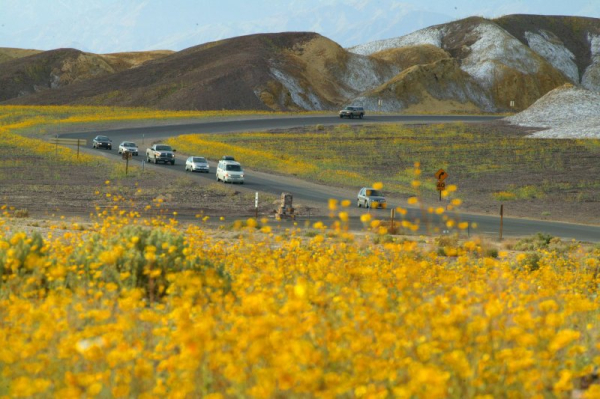
Vehicles head toward Furnace Creek past wild flowers in Death Valley National Park on March 17, 2005. File Photo by Terry Schmitt/UPI | License Photo
The rare superbloom that lit up Death Valley National Park in recent weeks is fading as an early-season heat wave bakes the Southwest.
“Due to hot weather and high winds, many areas are now past peak,” the National Park Service said earlier this week. On Tuesday, the temperature in Death Valley reached 100 degrees, tying the record for the earliest triple-digit temperature on record.
Some flowers remain in bloom, but the display is no longer what it was in late February and early March, when low-elevation hillsides were painted yellow and purple in a way not seen since 2016.
The bloom isn’t completely over yet in Death Valley. Flowers in higher elevations are expected to bloom between April and June, though the look will be different. Instead of broad, colorful hillsides, the park said these blooms tend to show up in smaller clusters between shrubs.
The same hot and windy conditions are also starting to shrink another recent curiosity in the park: Lake Manly.
The temporary lake formed in the basin during the wet stretch that helped set the stage for the bloom, but the water is beginning to evaporate as the pattern persists.
For anyone hoping to catch either sight, the window is quickly closing, and it’s hard to know when conditions will align to recreate this year’s rare sights in Death Valley.
Death Valley National Park celebrates 30th anniversary
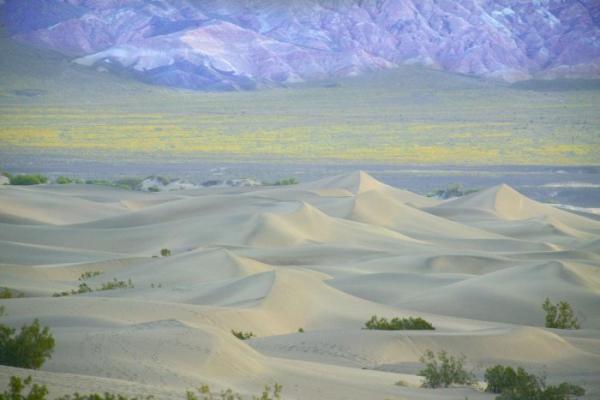
A wash of yellow covers a field between sand dunes and mountains at Death Valley National Park on March 17, 2005. Photo by Terry Schmitt/UPI | License Photo
