


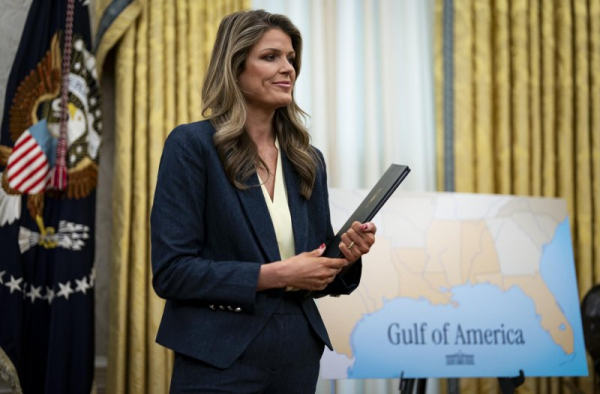
Lindsey Halligan, former attorney for U.S. President Donald Trump, has left the office of U.S Attorney for the Eastern District of Virginia. File Photo by Al Drago/EPA
Lindsey Halligan has stepped aside from the U.S. attorney role, Attorney General Pam Bondi announced Tuesday night, after a judge ordered her to stop “masquerading” as the top prosecutor for the Eastern District of Virginia.
Bondi praised Halligan for her service to the Justice Department while blaming Democrats for President Donald Trump’s former lawyer’s inability to continue on in her position.
“Her departure is a significant loss for the Department of Justice and the communities she served,” Bondi said in a statement posted late Tuesday to X.
“While we will feel her absence keenly, we are confident that she will continue to serve her country in other ways.”
The announcement came after U.S. District Judge David Novak for the Eastern District of Virginia prohibited Halligan from representing herself as the U.S. attorney before the court.
“Any such representation going forward can only be described as a false statement made in direct defiance of valid court orders,” Novak ruled.
“In short, this charade of Ms. Halligan masquerading as the United States Attorney for this District in direct defiance of binding court orders must come to an end.”
Halligan was tapped by President Donald Trump to prosecute his political rivals in mid-September as interim U.S. attorney for the Eastern District of Virginia after her predecessor, Erik Siebert, resigned amid pressure to bring charges against former FBI Director James Comey and New York Attorney General Letitia James.
Shortly after assuming the interim attorney title, Halligan, a former personal attorney to Trump who lacked any prosecutorial experience, brought charges against both Comey and James that raised scrutiny from legal experts over the quality of the evidence and whether she was legally able to serve in her new position.
On Nov. 24, U.S. District Judge Cameron Currie in South Carolina threw out both cases and ruled that Bondi’s attempt to install Halligan as interim U.S. attorney was “invalid.”
Siebert was selected to serve as interim U.S. attorney in January, a position with a legal limit of 120 days by which time he must be confirmed by the Senate.
Currie ruled that when Siebert’s 120 days expired on May 21, “so too did the Attorney General’s appointment authority,” relinquishing the power to select a new district attorney to the district court.
“Halligan has been unlawfully serving in that role since September 22, 2025,” Currie said.
Despite Currie’s order, Halligan continued to serve in the position.
Earlier this month, Novak called on Halligan to explain why she was continuing to serve in the position before the court despite her appointment being ruled unlawful.
On Jan. 13, Halligan responded in a filing by arguing the court was wrong in accusing her of misrepresenting herself as a U.S. attorney.
“Ms. Halligan is the United States Attorney, and Judge Currie’s ruling did not and could not require the United States to acquiesce to her contrary (and erroneous) legal reasoning outside of those cases,” she argued.
“The bottom line is that Ms. Halligan has not ‘misrepresented’ anything and the Court is flat wrong to suggest that any change to the Government’s signature block is warranted in this or any other case.”
In his ruling Tuesday, Novak chastised Halligan and Bondi, who joined her in the response, saying the filing “contains a level of vitriol more appropriate for a cable news talk show and falls far beneath the level of advocacy expected from litigants in this Court, particularly the Department of Justice.”
“At the end of the day, Ms. Halligan’s Response asserts that she is free to act in an unlawful capacity, because she disagrees that she does so unlawfully,” Novak said.
“But that’s not how our legal system works.”
He added that due to Halligan’s lack of prosecutorial experience, the court will grant her the benefit of the doubt and refrain from referring her for further investigation and disciplinary action concerning her misrepresentations in court.
Prior to the ruling being announced, the U.S. District Court for the District of Virginia listed a court order announcing that it is seeking to fill the position.
In response, Deputy Attorney General Todd Blanche suggested that whoever the court picks would be fired by Trump.
“It’s not likely, it’s guaranteed that the President gets to pick his U.S. attorneys,” he said on X.
