


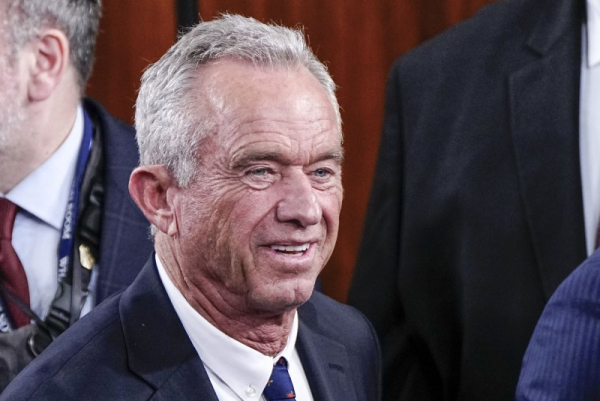
A federal judge on Monday blocked changes made to a CDC vaccine committee and the childhood vaccine schedule by Secretary of Health and Human Services Robert F. Kennedy Jr. because they likely violated the law. File Photo by Bonnie Cash/UPI | License Photo
A federal judge on Monday blocked all changes that Health and Human Services Secretary Robert F. Kennedy and a CDC vaccine committee he remade from going into effect.
Judge Brian E. Murphy ruled on a lawsuit against the Department of Health and Human Services by several medical associations that Kennedy’s hand-picked replacements on the Advisory Committee on Immunization Practices violated federal law, invalidating all of its recommendations to the CDC, CBS News, The Guardian and USA Today reported.
Kennedy replaced the 17-member ACIP with a smaller group of people, many of whom have questioned established medical research, to make changes to the CDC’s recommendations for a host of vaccines, including those for COVID-19, hepatitis A and B and influenza.
Kennedy then, bypassing the ACIP, unilaterally reduced the number of vaccines recommended for children from 17 to 11, and for many changed them from being universally recommended for all to children to only those at high-risk for infection.
“The Government bypassed ACIP to change the immunization schedules, which is both a technical, procedural failure itself and a strong indication of something more fundamentally problematic: an abandonment of the technical knowledge and expertise embodied by that committee,” Murphy wrote in his opinion.
He added that the removal of all ACIP members and replacing them with the “rigorous screening that had been the hallmark of ACIP member selection for decades” — another “procedural failure” — makes it likely that the new committee “fails to comport with governing law.”
The ACIP was established by Congress and founded in 1964 to provide expert guidance on the clinical use of vaccines, which, before Kennedy’s confirmation as HHS secretary, would then be evaluated by the director of the CDC before being adopted or sent back to ACIP for further consideration.
Murphy’s decision is based at least partially on federal law stating that a CDC “action is considered ‘final’ when it is ‘the consummation of the agency’s decision-making process,'” which was not followed based on Kennedy’s actions and announcements, he wrote.
The judge also pointed to the CDC’s longtime dedication to rigorous study and analysis of data that has led, as the agency itself has pointed out, to reductions in infection, hospitalization and death from a wide range of infectious diseases over the last 70 years.
“The CDC has consistently treated its role in promulgating the immunization schedules as arising only after ACIP has issued a recommendation,” Murphy wrote.
“Put simply, this is not the kind of agency action that is ‘committed to agency discretion,'” he wrote.
Experts expect HHS to appeal the decision, which HHS spokesperson Andrew Nixon confirmed in a statement to all three news organizations will happen.
“HHS looks forward to this judge’s decision being overturned just like his other attempts to keep the Trump administration from governing,” Nixon said.
This week in Washington

President Donald Trump speaks during an event celebrating Women’s History Month in the East Room of the White House on Thursday. Photo by Bonnie Cash/UPI | License Photo
