


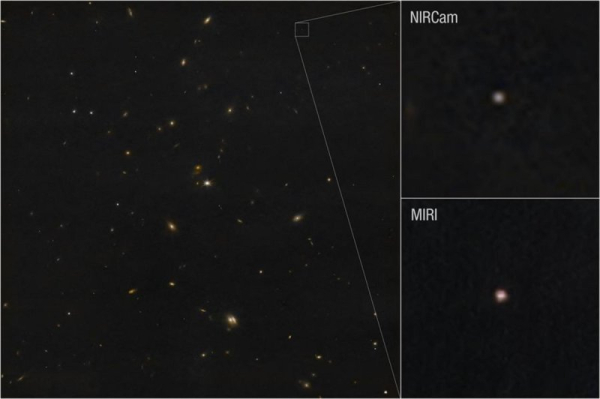
NASA scientists on Thursday ruled out the chance that near-Earth asteroid 2024 YR4 poses a threat to Earth or the moon in December 2032, which earlier data suggested could pose what the agency said was a “small, but notable” risk for impact. Photo by Andy Rivkin (APL)/STScl/CSA/ESA/NASA
NASA on Thursday walked back a prediction that an asteroid had a “small, but notable” chance of impacting Earth or the moon in 2032 based on newly analyzed data.
Scientists said that near-Earth asteroid 2024 YR4 is expected to pass by the lunar surface from more than 13,000 miles away, after previous concerns that it was destined for an impact with Earth’s natural satellite.
The update, which comes as 2024 YR4 has been unobservable from nearly all Earth and space-based observatories since spring 2025, is based on “where the asteroid is expected to be in 2032 rather than a shift in its orbital path,” NASA said in a news release.
“Over time, with more observations collected by observatories around the world, NASA concluded the object poses no significant risk to Earth on Dec. 22, 2032, or through the next century,” the space agency said. “It’s typical to have initial observations and risk models updated once additional observational data is gathered and models are able to be refined.”
The asteroid, which NASA said is 174 to 220 feet in size — roughly the size of a 10- to 15-story building — was discovered in late 2024 by NASA’s Asteroid Terrestrial-impact Last Alert System station in Chile.
Based on available data, the agency initially thought that 2024 YR4 posed a potential threat to Earth in 2032 but, by early 2025 NASA lowered the risk of an Earth impact to “near-zero.”
With that announcement, however, scientists said the risk for a lunar impact some time in 2032 had increased from 1.7% to 3.8%, which was later updated to a 4.3% chance of hitting the moon on Dec. 22, 2032.
The new analyses are of observations and data gathered by the James Webb Space Telescope on Feb. 18 and Feb. 26, which researchers at NASA’s Jet Propulsion Laboratory said “increased the certainty of where the asteroid will be in the future and decreased the range of possible locations.”
This use of the JSWT is among the faintest ever observations of an asteroid, NASA said.
“With this new data, 2024 YR4 is expected to pass by the moon at a distance of 13,200 miles and lunar impact is no longer a possibility,” they said.
NASA sends Crew-12 to ISS
SpaceX’s Falcon 9 rocket with NASA’s Crew-12 aboard lifts off from Launch Complex 40 at Cape Canaveral in Florida on February 13, 2026. Photo by Kate Benic/UPI | License Photo
