


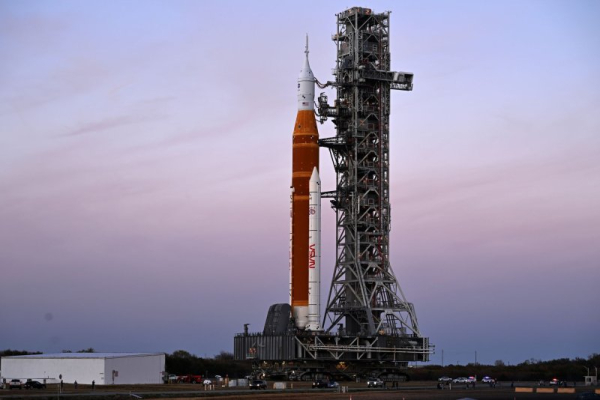
NASA plans to update the media on the Artemis II mission, and specifically the health of the Space Launch System rocket, which is pictured rolling back to the Vehicle Assembly Building from the launchpad in late February so that engineers could address a helium leak discovered during pre-launch testing. Photo by Joe Marino/UPI | License Photo
NASA said Thursday it plans to roll the Artemis II Space Launch System rocket and Orion capsule back out to the launchpad next week, aiming for a launch in early April.
The SLS and Orion will start rolling back out to the launch pad at Kennedy Space Center in Florida on March 19, with an eye at launching as early as the evening of April 1, NASA officials said during a press briefing.
The agency completed a flight readiness review for the SLS less than a month after the rocket was rolled back to the Vehicle Assembly Building in late February after a helium flow issue was discovered during pre-flight testing on the launch pad.
“At the conclusion of the [flight readiness review], all the teams pulled go to launch and fly Artemis II around the moon, pending completion of some of the work before we roll out to the launch pad,” Lori Glaze, acting associate administrator in NASA’s exploration systems development mission directorate, told reporters at the briefing.
“Every time we talk about this flight, it’s a tough flight and it is not without risk. But our team and our hardware are ready,” Glaze said. “We are planning to roll back out to the pad a week from today, on the 19th, and we are on track for that.
Artemis II is planned as the first crewed mission of the Space Launch System and Orion, and will take a four-astronaut team around the moon to test the new spacecraft’s systems and do research that will inform the eventual return of humans to the moon in the next few years.
The space agency on Feb. 3 delayed the Artemis II launch after engineers discovered the helium flow issue during critical pre-launch testing on the launchpad and rolled the Space Launch System and Orion back into the vehicle assembly building to address the problem.
Shawn Quinn, NASA’s manager of the exploration ground systems program, said that after a successful but frustrating wet dress rehearsal when the rocket was first brought out to the pad, engineers were able to quickly find the helium issue, come up with a design fix and successfully tested it.
Engineers also replaced several other systems and conducted other maintenance during the nearly three weeks the SLS spent back in the VAB, he said.
Quinn noted that the 22-day period from rolling out to the pad, back to the VAB for fixes and then being returned to the pad will be the team’s fastest turnaround thus far in the Artemis program.
Glaze said that all participants in the Artemis II mission participated in the flight readiness review, including the four astronauts who will fly the rocket for the first time: Victor Glover, Jeremy Hanson, Christina Koch and Reid Wiseman.
When NASA decided to forgo the February and March launch windows to roll back to the VAB for repairs, the astronauts were released from their pre-flight quarantine at KSC.
With the SLS and Orion’s 12-hour trip back to the launchpad set, Norm Knight, who is director of the flight operations directorate for the mission, said that the astronauts will re-enter pre-launch quarantine on March 18. Their arrival at KSC ahead of launch is scheduled for March 27.
Overall, Glaze said that NASA has four launch opportunities during a 6-day window that opens on April 1. The first two opportunities are a window that opens on April 1 at 6:24 p.m. EST and on April 2 at 7:22 p.m. EST if needed.
“While I’m comfortable, and the agency is comfortable, with targeting April 1 as our first opportunity, keep in mind we still have work to do,” Glaze said. “There are still things that need to be done within the VAB and out at the pad. As always, we’ll be guided by what the hardware is telling us and we will launch when we’re ready.”
The Artemis series of missions is planned to return humans to the moon for the first time since NASA’s last Apollo missions in the 1970s and establish a permanent human presence on the Earth’s only natural satellite.
On top of the moon missions, NASA has also set out longer term goals to eventually send humans to Mars.
Artemis has run into a series of issues over the last several years, including recurring technical failures with the SLS, SpaceX’s Starship — which will deliver astronauts to the moon’s surface — has yet to demonstrate reliability and various levels of turnover at NASA have all caused the moon program’s timeline to slip.
Artemis II rocket rolls out to the launchpad in Florida
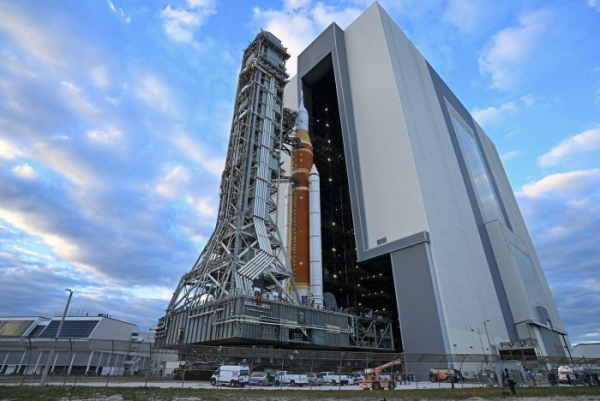
NASA’s Space Launch System rocket emerges on Saturday morning from the Vehicle Assembly Building to start its journey to Launch Complex 39B at the Kennedy Space Center in Florida. Photo by Joe Marino/UPI | License Photo
