


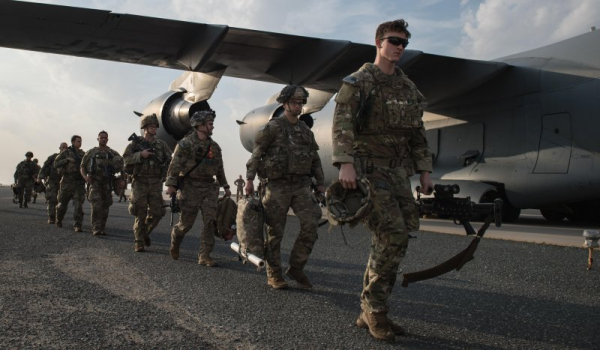
U.S. Army Paratroopers from the 82nd Airborne Division arrive at Ali Al..Salem Air Base, Kuwait, in January 2020. It was reported Tuesday that the Pentagon was to send a contingent of paratroopers from the division to the Middle East. File Photo by Tech. Sgt. Daniel Martinez/U.S. Air Force/UPI
The Pentagon has ordered paratroopers to the Middle East, as President Donald Trump pursues a diplomatic solution to the war with Iran while declining to rule out the possibility of launching ground operations, according to reports.
The contingent of paratroops to be deployed are from the Army’s 82nd Airborne Division, out of Fort Bragg, N.C., and will include Maj. Gen. Brandon Tegtmeier, the division commander, The New York Times, CNN and CBS News reported, citing unidentified sources.
The soldiers are specifically members of the 82nd Division’s Immediate Response Force, The Times, CNN and The Washington Post reported. According to the U.S. Army, the Immediate Response Force is its only division capable of beginning an airborne assault operation anywhere in the world within 18 hours of receiving orders.
Rep. Jason Crow, a Democrat from Colorado and a former paratrooper with the 82nd Airborne, lambasted Trump over the announcement Tuesday night.
“These paratroopers, and the American people, deserve better,” he said in a statement. “We must protect our service members and stop spending billions of dollars a day fighting overseas wars of choice, especially as folks back home can’t afford gas, groceries or healthcare.”
The announcement comes as Iran’s claimed closure of the Strait of Hormuz, through which flows about 20% of the world’s oil supplies, has seen energy prices surge and nations scrambling to mitigate the effects on their economies.
It was unclear exactly how many the paratroops would be deployed or where they would be sent, but their deployment could give Trump a rapid-response force in the region, while representing an escalation in the conflict.
Earlier this month, U.S. Central Command said it had struck more than 90 military targets on the Kharg Island, a key location in Iran’s ability to enforce its maritime blockade, including naval mine storage facilities, missile storage bunkers and other military sites.
Trump described the strike as “one of the most powerful bombing raids in the History of the Middle East, and totally obliterated every MILITARY target in Iran’s crown jewel, Kharg Island.”
“For reasons of decency, I have chosen NOT to wipe out the Oil infrastructure on the Island,” he wrote on his Truth Social platform. “However, should Iran, or anyone else, do anything to interfere with the Free and Safe Passage of Ships through the Strait of Hormuz, I will immediately reconsider this decision.”
Trump on Saturday had given Iran a 48-hour ultimatum to open the strait or the U.S. military would “obliterate” its power plants, to which Iran’s parliament speaker, Mohammad Bagher Ghalibaf, responded that if the American president makes good on his threat, critical and energy infrastructure and oil facilities would be “irreversibly destroyed.”
On Monday, Trump announced that he had extended the ultimatum five days after having what he called “very good and productive conversations” on a solution to the war with Iran.
Trump said Tuesday that negotiations with Iran were underway and that the Iranians “want to make a deal.”
The extent of the negotiations was unclear.
