


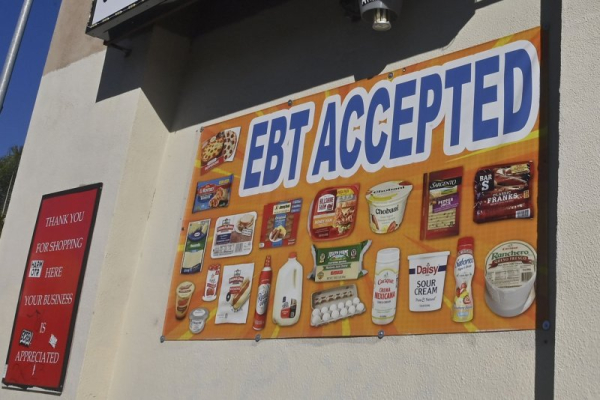
A sign outside a store in Los Angeles on Sunday advertises that Electronic Benefit Transfer for Supplemental Nutrition Assistance Program. Photo by Jim Ruymen/UPI | License Photo
Full food assistance program benefits will begin flowing to around 42 million Americans within one day after legislation ended the longest government shutdown at 43 days on Wednesday.
For the first time since its inception in 1939, the U.S. government failed to issue monthly assistance in November. The food stamp program was officially renamed as the Supplemental Nutrition Assistance Program in 2008.
Benefits are loaded into Electronic Benefits Transfer, which are debit-type cards issued by the Department of Agriculture.
A USDA spokesperson told CBS News and USA Today that recipients in most states will get their benefits “within 24 hours” after the government shutdown ends.
The payment process has become confusing because 16 states have issued full benefits for November, while 13 others have sent partial or no payments until a pause by the U.S. Supreme Court on Friday, according to research by the Food Research and Action Center
Also, full payments are staggered throughout the month.
“States that did not issue full benefits earlier will need to resubmit their files to their EBT vendors for processing, which may take a few additional days,” Gina Plata-Nino, SNAP director at the Food Research & Action Center, told CBS News.
The announcement comes as the House has sent legislation to reopen the government to the desk of President Donald Trump, who signed it into law late Wednesday. The bill will keep SNAP benefits covered for all of next year.
The average monthly benefit is $188 per person. Benefits are determined by household size, income and state.
Benefits generally go to households at or below 130% of the poverty line. Recipients include the elderly, disabled and children.
Allowable gross monthly income ranges from $1,696 per month up to $3,483 for four people in a household, according to the USDA. For each additional member, the income can be $596 higher.
A new 2025 federal law requires recipients ages 18-64 without dependents to work at least 80 hours a month or participate in an approved work program.
In a flurry of legal activity Friday night, an appeals court upheld Rhode Island District Judge Jack McConnell’s order from the day before for full payments. Subsequently, the Trump administration appealed to the high court. Then, a ruling by Supreme Court Justice Ketanji Brown Jackson temporarily blocked the order.
On Tuesday, the high court extended the pause of the district judge’s ruling that ordered the Agricultural Department to fully fund the program.
On Nov. 3, the agency said it would distribute half of the $9 billion monthly cost from a contingency fund.
The government in a court filing said depleting that reserve means “no funds will remain for new SNAP applicants certified in November, disaster assistance, or as a cushion against the potential catastrophic consequences of shutting down SNAP entirely.”
Nevertheless, the amount was raised to 65% on Thursday, the day the district judge required full payment.
He directed USDA to find $4 billion “in the metaphorical couch cushions.”
McConnell said the administration could use Section 32 funds, which the USDA uses to help with child nutrition programs. But the administration rejected that plan.
In the appeal, the DOJ claimed that the judge’s order “makes a mockery of the separation of powers.” Lawyers said transferring funds would mean diverting money from Child Nutrition Programs.
