


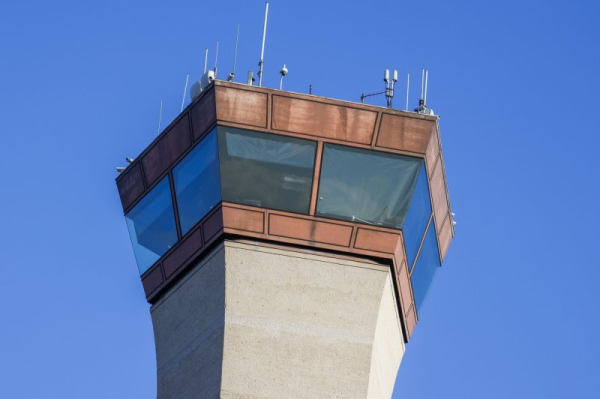
A control tower overlooks O’Hare International Airport in Chicago on Friday, which reported the most cancellations and departures in the nation. Photo by Tannen Maury/UPI | License Photo
The Federal Aviation Administration on Wednesday froze mandated flight reductions at 6% because there were fewer flight cancellations and delays with better air traffic control staffing during the federal government shutdown.
Wednesday was the second day of mandated 6% cancellations. On Thursday, the percentage was scheduled to rise to 8% but the FAA kept them at that percentage because of “strong staffing metrics.”
A 4% reduction went into effect on Friday.
“The FAA safety team is encouraged to see our air traffic control staffing surge, and they feel comfortable with pausing the reduction schedule to give us time to review the airspace,” Transportation Secretary Sean Duffy said in a statement obtained by airspace,” Transportation Secretary Sean Duffy said in a statement obtained by CNN. “If the FAA safety team determines the trend lines are moving in the right direction, we’ll put forward a path to resume normal operations.”
The decision was two days after President Donald Trump wrote on Truth Social: “Air Traffic Controllers must get back to work, NOW!!! Anyone who doesn’t will be substantially ‘docked.’ ”
“President Trump’s message has been heard loud and clear: controllers will be made whole quickly,” Duffy said.
The numbers Wednesday are the lowest since the Federal Aviation Administration mandated cuts on Friday at 40 high-traffic airports, but airlines have been pre-emptively cancelling flights, which are not counted in the daily statistics.
As of 8 p.m. EST Wednesday, 904 flights within the U.S. had been canceled and 2,203 were delayed, according to flight tracking website FlightAware.
The high was Sunday when there were 3,498 cancellations and 11,229 delays.
These numbers include weather, mechanical issues and airline staff issues.
There were nine reports of staffing shortages at air traffic control facilities on Wednesday, which is up from five on Tuesday but below 63 reported on Saturday.
Air Route Traffic Control Centers in Albuquerque, Jacksonville, Indianapolis and New York were short-staffed Wednesday night.
Terminal Radar Approach Control, or TRACON, which handles approaching and departing planes, cited shortages in Orlando, Detroit and Newark.
“If this doesn’t open, you might have airlines that say, ‘We’re going to ground our planes. We’re not going to fly anymore,'” Transportation Secretary Sean Duffy said Tuesday night. “That’s how serious this is.”
Even with House passage of a funding bill, the staffing levels won’t change immediately.
Air traffic controllers have been required to work without pay during the shutdown. But some workers are calling out, and some are resigning.
Controllers will receive 70% of their back pay within 48 hours of the government shutdown ending and 30% within a week, Duffy said. A $10,000 bonus has been proposed by President Donald Trump for those who were on the job.
Duffy said that he and FAA safety officials will decide to cut back on mandates by looking at data, including pilot complaints, incidents where planes fly too close together and runway incidents.
Airlines are hoping staff will be ramped up before Thanksgiving travel in two weeks. The holiday weekend is the busiest time of year in the nation.
“We’re going to be OK for Thanksgiving,” Delta CEO Ed Bastien told CNBC. “We’ve got to get the vote done, and so we’re counting on Congress doing their job and making that happen. But Thanksgiving will be fine.”
He said Delta cut 2,500 flights last week, which “is going to cost Delta a significant amount.”
In a letter, United Chief Executive Officer Scott Kirby said the airline has given “our customers as much notice and flexibility as possible, knowing the circumstances were ever-changing.”
That includes using an app to alert customers of alternative flights to get them to their destinations and offering refunds to all customers, even if their flights hadn’t been canceled.
Duffy flew to O’Hare International Airport where he spoke to reporters.
“IT IS SAFE TO FLY! I checked in with travelers at Chicago O’Hare … and every one of them wants the government to reopen so there are fewer delays and cancellations!” Duffy posted Wednesday on X with video from Tuesday.
IT IS SAFE TO FLY! I checked in with travelers at Chicago O’hare… and every one of them wants the government to reopen so there are fewer delays and cancellations!
House members, do the right thing today and pay our air traffic controllers.#CheckInWithSean pic.twitter.com/QrVXGhWDQp— Secretary Sean Duffy (@SecDuffy) November 12, 2025
American and United, with major operations in Chicago, were affected by a snowstorm on Monday night.
O’Hare continues to top cancellations and delays nationwide.
The airport, which is the second-busiest in the nation, reported 3% cancellations: 46 departures and 47 arrivals. There were more than 200 total delays in both directions.
The smaller Midway International in Chicago reported about 3% cancellations and 2% delays.
Denver International Airport, which is bracing for its first snowfall of the year, was second nationally for cancellations — 43 departures, or 4%, and 45 arrivals, or 5%. Delays totalled 64.
Atlanta’s Hartsfield-Jackson International Airport, with the most traffic in the nation, was third for cancellations with 3% — 37 departures and 38 arrivals. Cancellations were nearly 90.
Southwest Chief Operating Officer Andrew Watterson said Wednesday in a news release that airlines are optimistic the FAA will “allow airlines to resume normal operations within a few days, enabling us to return to our full schedule in the very near future.”
