



1 of 3 | House Speaker Mike Johnson of Louisiana talks during a press conference outside the U.S. Capitol on Nov. 5. The House plans to vote on the Senate’s temporary funding bill Wednesday night. Photo by Bonnie Cash/UPI | License Photo
The U.S. House, convening for the first time in two months Wednesdsay, cleared a key procedural vote on legislation pproved two days earlier by the Senate to reopen the government, 43 days after the start of the shutdown.
After the House Rules Committee advanced the Senate bill Tuesday night, the full chamber convened at 4:08 p.m., and began debate for one hour at 4:36 p.m.
The bill advanced 213-209.
The House proceedings are being live-streamed.
Final voting should be done by 7:15 p.m., at which point the legislation, if it passes, will be sent to President Donald Trump’s desk for a signature. Trump indicated he would sign it.
“I’ll abide by the deal,” he said Monday. “The deal is very good.”
Unlike the Senate, where 60 votes are needed, passage in the House only requires a majority vote. The GOP has a 219-214 advantage, with Democrat Adelita Grijalvi having been sworn in when the House convened. She was elected Sept. 23.
House Speaker Mike Johnson said he was confident of approval.
“For 40 days, hardworking Americans have endured flight cancellations, missed paychecks and empty dinner tables – all because Democrats closed the government,” Johnson posted on X with a video.
“It was foolish, pointless, cruel and entirely avoidable. Republicans have been working every day to get the government reopened for the American people, and today we should finally be able to overcome the Democrats and accomplish our mission.”
He said a provision would be stripped regarding funds for eight senators to sue the Department of Justice for obtaining their phone records during an investigation when Joe Biden was president.
“House Republicans are introducing standalone legislation to repeal this provision that was included by the Senate in the government funding bill,” Johnson posted on X on Wednesday afternoon. “We are putting this legislation on the fast-track suspension calendar in the House for next week.”
Democrats have opposed the provision.
“What makes this corruption so staggering is that the payout is specifically designed to go to eight senators whose phone records were lawfully subpoenaed under due process by the Department of Justice,” Rep. Rosa DeLauro, the top Democrat on the House Appropriations panel, wrote in a statement. She accused the senators of voting “to shove taxpayer dollars into their own pockets — $500,000 for each time their records were inspected.”
The House had been out of session since Sept. 19, when it passed the first version of a continuing resolution to temporarily fund the government. The Senate held 14 votes on the same legislation, but failed to reach the 60-vote supermajority needed to pass it.
A majority of Democrats voted against the legislation, seeking to tie the funding bill to a renewal of enhanced Affordable Care Act tax subsidies set to expire in the new year.
The Senate broke the impasse over the weekend after Republicans agreed to hold a separate vote on ACA tax credits. Unnamed sources told ABC News that Republicans promised to hold a vote on the issue in December, though House Speaker Mike Johnson has yet to commit to voting on any ACA measure passed by the Senate.
The credits were enhanced in 2021 by the American Rescue Plan Act during the pandemic and extended one year later through 2015. They increased the amount of financial assistance, expanded eligibility and capped the percentage of household income for the benchmark silver plan.
Eight senators who caucus with the Democrats voted Monday in favor of the new bill on Tuesday night, allowing the chamber to pass it with a vote of 60-40.
The new stopgap bill would fund the government through Jan. 30, provide a full year of funding for the Supplemental Nutrition Assistance Program and veterans programs.
Democrats criticized the bill.
“As Democrats, we’re committed to addressing this affordability crisis. That’s what this fight has been all about,” House Minority Leader Hakeem Jeffries said outside the Capitol. “We’ll continue this fight to fix our broken healthcare system.
“We’ll continue to fight for the principle that in this great country, the wealthiest country in the history of the world, healthcare can’t simply be a privilege available only to the well-off, the wealthy and the well-connected.
“:Health care must be a right available to every single American. And that’s the fight that House Democrats will continue to wage for the American people.”
Though approval is unlikely, Jeffries will offer a three-year extension of Obamacare by with a discharge petition. There would be a vote if the minority party can secure support for a majority of the chamber — a total of 218 signatures. But there are only 214 Democrats and sufficient GOP backing is unlikely.
“Affordable Care Act tax credits were extended by three years in the Inflation Reduction Act,” Jeffries said. “The legislation that we will introduce in the context of the discharge petition will provide that level of certainty to working-class Americans who are on the verge of seeing their premiums, copays and deductibles skyrocket in some cases, experiencing increases of $1,000 or $2,000 per year.”
Colorado Rep. Jeff Hurd said he wants to extend the enhanced premium tax credits for time to work on “the underlying drivers that are pushing up those health care costs to begin with.”
This week in Washington
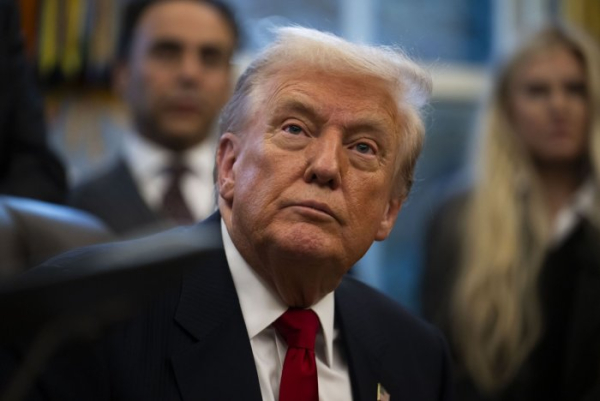
President Donald Trump speaks to members of the media during a swearing in ceremony for Sergio Gor, the new U.S. Ambassador to India, in the Oval Office of the White House on Monday. Photo by Craig Hudson/UPI | License Photo
