


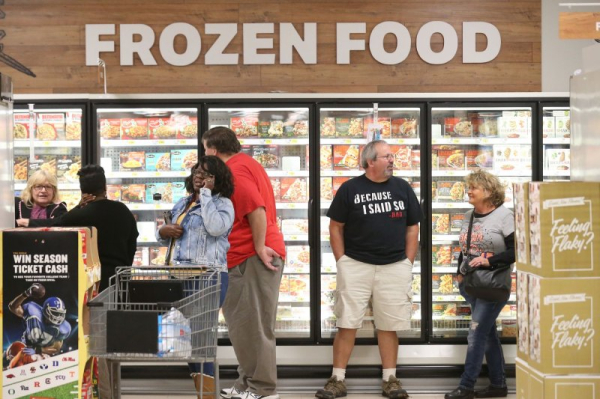
Americans still struggle with the high cost of living as inflation has remained above Federal Reserve goals and economic data was delayed by the government shutdown. File Photo by Bill Greenblatt/UPI | License Photo
Economic markers say inflation has slowed and steadied since 2023 but consumers are still feeling the effects of high costs of living.
Americans continue to feel the squeeze of high prices and wages that are not keeping up, Dr. Kathleen Mulligan, director of labor leadership initiatives at Cornell University School of Industrial and Labor Relations, told UPI.
“For the most part things are getting worse,” she said. “We’re seeing increased costs. What we know from decades of work is that people know when they don’t have enough money. That’s not something you can try to convince people they do have enough money when they don’t.”
The Consumer Price Index report from September, a government-reported index that measures the average change in prices paid for goods and services, showed that costs are up 3% over September 2024. This follows a fairly steady trend dating back to 2024.
The federal government usually publishes economic reports like the CPI monthly but reports have been delayed due to the record 43-day government shutdown.
Looking at core grocery items, such as milk, eggs, chicken and ground beef, prices were up about 5%. Through the first half of 2025, prices for these goods increased about 6.5% over the first half of 2024. From the first half of 2023 to the first half of 2024, they increased less than 1%.
Inflation hit a record high of 9% in June 2022, based on the CPI. It steadily decreased from that point to June 2023 when it settled at 3%.
Energy prices also continue to rise. Utility gas prices increased by 11% in the first half of the year after showing a 7% decrease in the first half of 2024. As a whole, energy costs were up 3% in September over the previous 12 months.
Housing and rent prices continue to be an area where people are feeling the biggest squeeze. Rent prices remain sharply above pre-pandemic levels, rising more than 4% this year. However, that increase has slowed from roughly 8% in 2023 and 2024.
The cost of healthcare coverage is at the forefront for millions of Americans who face rising premiums.
President Donald Trump’s budget reconciliation act that passed this past summer will cut an estimated $792 billion from Medicaid funding over the next 10 years. Increased eligibility requirements will see 15 million people lose healthcare coverage or become underinsured, the Center of Budget and Policy Priorities estimates.
U.S. Congress has not yet taken action to extend the Affordable Care Act’s enhanced premium tax credits ahead of the Dec. 31 deadline to do so. If those credits expire, more than 20 million people face the likelihood of higher out-of-pocket expenses for healthcare, or the inability to afford healthcare coverage.
The cost of medical care in the United States has increased by 600% since 1984.
The CPI is a weighted average of prices with the period of 1982 through 1984 as its baseline, measured at an index of 100. An index higher than 100 means an increase in prices. It does not take into account factors like wages, only the costs of goods and services.
“Wages in this country have been fairly stagnant since the late ’70s,” Mulligan said. “What that means is that workers are more and more productive. Our [gross national product] and [gross domestic product] have grown tremendously but workers haven’t seen the benefit of increasing productivity. We seek workers getting squeezed from every end.”
The Federal Reserve Bank of St. Louis tracks wages across a broad array of populations in the United States. Its report on the median usual weekly earnings of wage and salary workers 16 years old and older shows the middle — not average — wage of full-time workers in the context of the CPI. This measurement represents real purchasing power in the face of inflation.
The FRED data shows that purchasing power has largely stagnated in 2025 for the median-wage worker, staying at about $376 per week between the second and third quarter. That is up $1 over the fourth quarter of 2024.
The Federal Reserve Bank of Atlanta measures the rate that wages increase, not adjusted for inflation and not using job averages. It is effectively a measurement of changes in wages before inflation, on a three month average.
In June and July 2022, overall median wage growth reached 6.7%, up from about 3.4% in January 2021, when Trump’s first presidential term ended. Wage growth remained at or above 5% through February of 2024 and occasionally ticked above 5% again through June of that year.
Since January, wage growth has plateaued around 4%. This means that while wages are increasing, they are not increasing at as quick a pace as they did from 2021 to 2024. This makes it more difficult for wages to close the gap with rising costs of groceries, shelter and energy.
“We’re essentially seeing the collapse of the American dream in real time,” Mulligan said. “For Millennials and maybe Gen X there’s still some possibility of owning a home and having a family. We certainly hear from younger Millennials and the generations below that there’s no expectation of being able to own a home or to get a job that pays enough and offers enough support to create stability for workers to be able to support a family.”
This week in Washington

President Donald Trump participates in a Hanukkah reception in the East Room at the White House on Tuesday. Photo by Yuri Gripas/UPI | License Photo
