



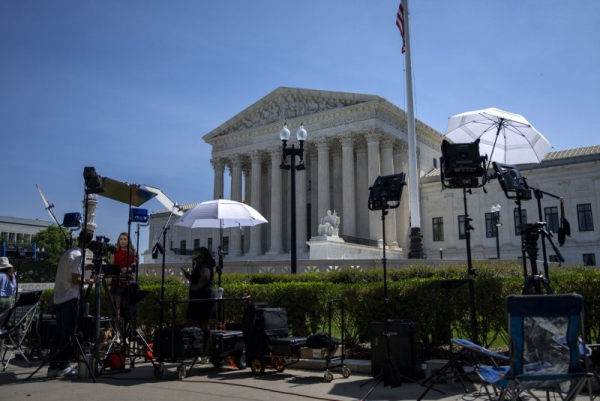
News anchors are seen outside the Supreme Court of the United States in Washington, D.C., as the court releases their final opinions before summer recess on Tuesday. Photo by Bonnie Cash/UPI | License Photo
The U.S. Supreme Court on Tuesday rejected President Donald Trump’s attempts to kill automatic birthright citizenship, prompting the leader to call on Congress to end the practice through legislation.
The high court voted 6-3 against Trump’s executive order banning birthright citizenship, with Chief Justice John Roberts writing for the majority. He said birthright citizenship is guaranteed by the Constitution and there was “scant evidence” for Trump’s interpretation of the law protecting birthright citizenship.
The 14th Amendment was enacted after the Civil War to protect the rights of the formerly enslaved.
“Citizenship then and now, was the right to have rights — to freely participate in our political community,” Roberts wrote. “We keep that promise today.”
Trump reacted to the news with a call to action from Congress.
“The Supreme Court upheld Birthright Citizenship, which is too bad for our Country, but we can easily make it up in Congress through Legislation, with the support of the President, that has now been determined during this process,” he wrote in a post on Truth Social.
“No long and unwieldy Constitutional Amendment is necessary! Congress should start TODAY to work on ending expensive and unfair to our Country, Birthright Citizenship. They have my Complete and Total Support!”
The American Civil Liberties Union celebrated what it described as a “historic decision that reaffirms that the Constitution — not the president — defines who gets to be a citizen.”
The ACLU’s Cecelia Wang, who argued the case before the Supreme Court in April, told CNN that she wishes Republicans in Congress “good luck” in trying to change the law.
“Ask any American what our citizenship rule is, and they will tell you if you’re born here, you’re a citizen, just like everyone else, and that couldn’t be more fundamental to who we are as a nation,” she said.
Trump became the first U.S. president to sit in on oral arguments before the Supreme Court when the panel heard the case in April.
Arguments in part centered on what constitutes being domiciled in the United States. Trump’s lawyers argued that since undocumented immigrations aren’t in the United States legally, they’re not domiciled nor are they pledging allegiance to the United States. Therefore, they said, their children should have no claims to U.S. citizenship.
Supreme Court Justice Elena Kagan questioned why the Trump administration was getting into the semantics of the word when it isn’t included in the language of the citizenship clause of the amendment.
“The text of the clause, I think, does not support you,” she told Solicitor General D. John Sauer, who represented Trump in the case. “I think you’re sort of looking for some more technical, esoteric meaning.”
Roberts described the “domicile” argument by the Trump lawyers as “very quirky.”
A Pew Research Center analysis found that 32 other countries have birthright citizenship laws similar to the United States, including Canada, Mexico, Brazil, Pakistan and Venezuela.
Birthright citizenship is generally automatic in the United States with the exception of children born to foreign diplomats, born on foreign public ships in U.S. waters and born to foreign enemies with the United States during a hostile occupation.
Protesters march in ‘Day Without Immigrants’ rally
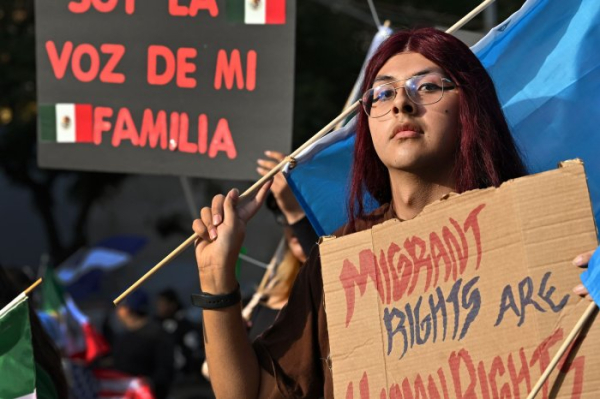
Protesters take to the streets and march as part of the nationwide “Day Without Immigrants” rally in downtown Los Angeles on February 3, 2025. Photo by Chris Chew/UPI | License Photo
