


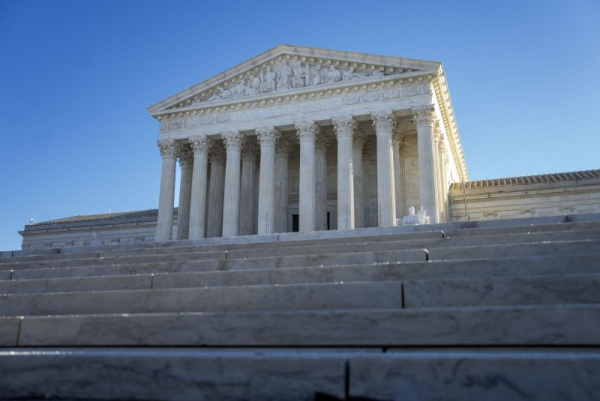
The U.S. Supreme Court ruled unanimously that Internet service providers can’t be held responsible for music piracy by their customers, though two liberal judges offered differing reasons for their decisions. File Photo by Bonnie Cash/UPI | License Photo
The U.S. Supreme Court ruled in favor of Cox Communications on Wednesday in a case questioning the extent to which Internet service providers are responsible for policing music privacy.
The court said record companies, including Sony Music Entertainment, cannot expect ISPs to disconnect customers who illegally download music using their service. The justices voted unanimously for Cox, with Justice Clarence Thomas writing for the majority.
“Under our precedents, a company is not liable as a copyright infringer for merely providing a service to the general public with knowledge that it will be used by some to infringe copyrights,” he wrote.
Justices Sonia Sotomayor and Ketanji Brown Jackson wrote their own concurring opinion, saying Thomas’ ruling is too narrow in its judgment of Cox’s secondary liability “without any meaningful explanation.”
“Plaintiffs cannot prove that Cox had the requisite intent to aid copyright infringement for Cox to be liable on a common-law aiding-and-abetting theory,” Sotomayor wrote.
The case pitted Cox Communications against Sony Music Entertainment and more than 50 other record labels that represent artists such as Sabrina Carpenter, Givēon and Doechii. Cox is the largest private broadband company in the United States, providing Internet to more than 6 million homes and businesses.
The case stems from a 2019 case in which a jury said that Cox should pay more than $1 billion in damages to a coalition of record companies for failing to do more to stop copyright violations. The 4th U.S. Circuit Court of Appeals threw out the judgment after reviewing the case, but Cox has asked the Supreme Court to rule as well.
The coalition of record labels accused Cox of failing to properly act on notices they sent the ISP about Internet users violating the Digital Millennium Copyright Act. The Recording Industry of America pays an anti-piracy company to automatically send notices to Internet providers when it detects evidence of music piracy.
Cox had a 13-strike policy regarding copyright infringement, at which point the user’s account would be terminated. The coalition said Cox didn’t abide by its own policy.
“Cox made a deliberate and egregious decision to elevate its own profits over compliance with the law,” the coalition said.
Cox, however, said it should not be liable for the illegal actions of its users. The company said it never encouraged copyright violations and never made money off the illegal behavior.
Cox said it’s unreasonable for the company to be punished for not cutting off the Internet service “after receiving automated notices accusing an unknown user at a home or business” of copyright infringement. Lawyers said it would force Cox to cut off Internet service at an entire location based on a “bare accusation” against a single user. Hospitals, hotels and other businesses with hundreds of users would be subject to this policy.
“That notion turns Internet providers into Internet police and jeopardizes Internet access for millions of users,” a filing by Cox read.
The U.S. Justice Department, the American Civil Liberties Union, and businesses such as X and Google, had shown support for Cox in the case.
“Parents’ Internet access … may be terminated based on the conduct of their children — over even their children’s friends,” the ACLU wrote in a joint filing in the case. “A hospital that offers Internet access to dozens or even hundreds of patients and their families could find critical access shut off.”
This week in Washington
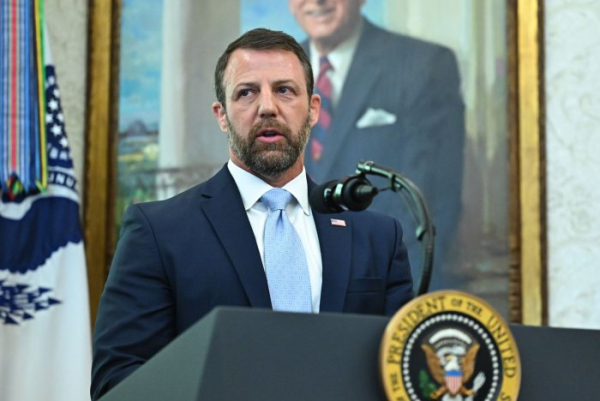
Secretary of the Department of Homeland Security Markwayne Mullin speaks during a swearing-in ceremony in the Oval Office of the White House on Tuesday. Mullin was confirmed Department of Homeland Security secretary, placing the former Oklahoma senator in charge of a Trump administration immigration crackdown that has triggered a 37-day funding shutdown of the Cabinet agency. Photo by Graeme Sloan/UPI | License Photo
