



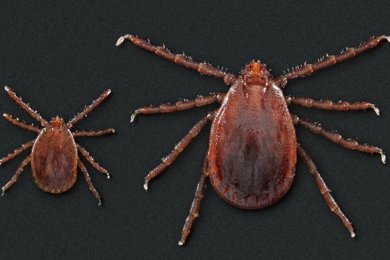
Emergency room visits for tick bites in April 2026 were up by almost double over those reported in April 2025. File Photo courtesy of CDC
Emergency room visits for tick bites climbed in April compared to the same month last year, a sign that tick activity is ramping up as millions of people head outdoors for yard work, hiking, camping and sports.
According to the Centers for Disease Control and Prevention’s Emergency Department Tick Bites by Month data, emergency room visits for tick bites hit 105 cases in April, compared to 68 cases in April 2025. That marks a roughly 54 increase from the same period last year.
Most tick bite cases were reported in the Northeast, with 80 cases, followed by the Midwest, with 56 cases, according to the CDC data. Both regions include areas where tick-borne illnesses such as Lyme disease are a recurring concern during the warmer months.
The rise comes before the typical early-season peak. Last year, ER visits for tick bites topped out in May with 129 visits, meaning this year’s April total is already nearing the level seen during the peak month of 2025.
The CDC said in an April statement that weekly emergency room visits for tick bites were higher than usual in many parts of the United States. In every region except the South Central states, weekly rates of tick bite-related ER visits were the highest for this time of year since 2017.
Ticks can be active whenever temperatures are above freezing, but encounters increase in spring and early summer as vegetation thickens and people spend more time in wooded, brushy or grassy areas. Warm, humid conditions can help ticks avoid drying out, while leaf litter, tall grass and shaded yards can provide protected habitat.
Weather does not explain every spike in tick activity. Tick populations are also influenced by deer, mice, birds, acorn cycles and local habitat. But weather can affect both sides of the risk equation: how active ticks are and how often people are outdoors in places where ticks live.
“Tick season is here and these tiny biters can make you seriously sick,” CDC epidemiologist Alison Hinckley said in the agency’s April statement. The CDC urged people to take steps to prevent bites and remove attached ticks as soon as possible.
Lyme disease is the most commonly reported tick-borne illness in the U.S., but ticks can also spread Rocky Mountain spotted fever, anaplasmosis, ehrlichiosis, babesiosis and alpha-gal syndrome, a potentially serious allergy linked to some tick bites.
The Northeast and Midwest often see high tick activity during the spring and early summer, though risk varies widely by state, county and even neighborhood.
The highest-risk areas are often not deep in the woods, but along the edges of daily life: where lawns meet brush, where pets walk through tall grass, where children play near leaf piles and where hikers brush against vegetation along trails.
People can lower the risk of tick bites by using EPA-registered insect repellent, wearing long sleeves and pants in wooded or grassy areas, treating clothing and gear with permethrin, checking pets and showering soon after coming indoors. The CDC says attached ticks should be removed promptly with clean, fine-tipped tweezers and that people should watch for symptoms such as fever, rash, fatigue, headache, muscle aches or joint pain after a bite.
