


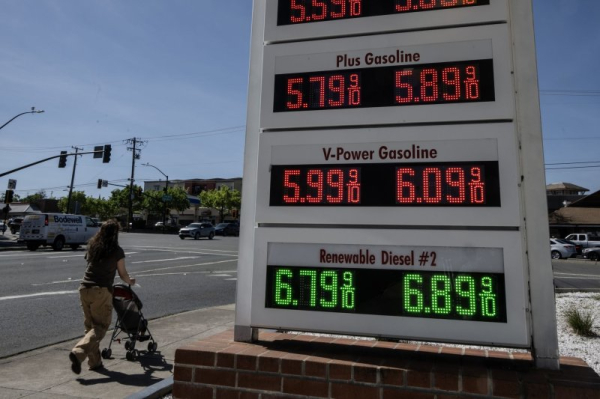
Gas prices were up in Walnut Creek, Calif., on March 10. To help ease the surge of gas prices in the United States, President Donald Trump temporarily waived the Jones Act, allowing more foreign shipments of oil to travel between U.S. ports. Photo by Terry Schmitt/UPI | License Photo
President Donald Trump issued a 60-day temporary waiver of the 106-year-old maritime law known as the Jones Act to battle rising gas prices as a side effect of the war in Iran, the White House announced Wednesday.
White House press secretary Karoline Leavitt said the waiver will increase the flow of oil, natural gas, fertilizer and coal into U.S. ports.
“President Trump’s decision to issue a 60-day Jones Act waiver is just another step to mitigate the short-term disruptions to the oil market as the U.S. military continues meeting the objectives of Operation Epic Fury,” she said in a statement on X.
The Jones Act requires that cargo traveling between U.S. ports be flagged in the United States, be at least 75% owned by U.S. citizens and be at least 75% crewed by U.S. citizens. The act, passed in 1920, was established to grow domestic shipping in the wake of World War I.
The Trump administration said last week it was considering temporarily waiving the rules to allow foreign-owned and -operated oil and fuel tankers to move between ports in an effort to limit rising gas prices across the country.
James Lightbourn, founder of Cavalier Shipping, said U.S.-flagged tankers typically cost about $50,000 more per day to operate than foreign vessels. Using foreign vessels is expected to cut the transportation costs of fuel by about 5 cents per gallon, The New York Times reported.
U.S. gas prices have surged by 27% and diesel by 34% since the United States and Israel began launching attacks on Iran on Feb. 28 amid negotiations over Iran’s nuclear program, AAA reported this week. The national average cost for a gallon of gas was $3.842 Wednesday morning and diesel was $5.068 per gallon.
A year ago, those prices were $3.078 and $3.592, respectively. A month ago, they were $2.917 and $3.651.
The U.S. attacks, which killed Iran’s supreme leader, Ayatollah Ali Khamenei, prompted Tehran to effectively close down the Strait of Hormuz by banning ships linked to the United States or Israel. About 20% of the world’s oil runs through the waterway that separates Iran and Oman.
Diesel prices are particularly tied to the U.S. economy, which depends on it for the transportation of goods via trucks, trains and barges. Recent surges in prices could have a cascading effect.
Trump this week put pressure on other nations that rely on oil shipped through the Strait of Hormuz to join a coalition to police the transit route and reopen traffic.
Speaking aboard Air Force One on Sunday, Trump said the United States doesn’t need to be involved in reopening the Strait of Hormuz because little of its oil passes through the waterway. About 7% of the United States’ crude oil and condensate imports passed through the strait in the first half of last year, the U.S. Energy Information Administration said.
He said the United States was protecting it “almost like we do it for habit” and to help “some very good allies that we have in the Middle East.”
Iran: Funerals held for those killed in airstrikes

Iranians attend a funeral for a person killed in recent U.S.-Israel airstrikes at Behesht-e Zahra cemetery on the southern outskirts of Tehran in Iran on March 9, 2026. Photo by Hossein Esmaeili/UPI | License Photo
