


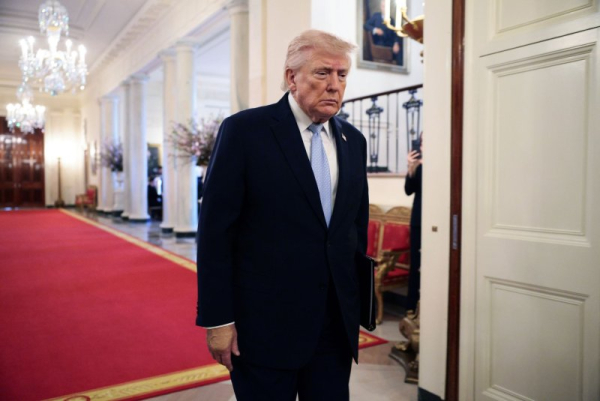
President Donald Trump arrives for the Commander in Chief Trophy presentation in the East Room of the White House in Washington, D.C., on Friday. Earlier in the day, he criticized NATO countries for declining to assist the United States in reopening the Strait of Hormuz. Photo by Shawn Thew/UPI | License Photo
President Donald Trump on Friday called fellow NATO members “cowards” for not helping to reopen the Strait of Hormuz after U.S. and Israeli attacks on Iran effectively closed the waterway through which 20% of the world’s oil is transported.
Trump made the comment days after demanding that other nations that rely on oil shipped through the Strait of Hormuz join his coalition to reopen and police the important trade route. It has become increasingly dangerous to transit the waterway between Iran and Oman amid ongoing violence in the region and after Iran closed the passage to the United States and its allies.
Trump called NATO a “paper tiger,” an expression used to describe someone or something that purports to be powerful but is actually weak and ineffectual.
“They didn’t want to join the fight to stop a Nuclear Powered Iran,” Trump said in a post Friday morning on Truth Social.
“Now that fight is Militarily WON, with very little danger for them, they complain about the high oil prices they are forced to pay, but don’t want to help open the Strait of Hormuz, a simple military maneuver that is the single reason for the high oil prices. So easy for them to do, with so little risk.
“COWARDS, and we will REMEMBER!”
Despite Trump’s complaints, the leaders of several NATO countries — Britain, Canada, France, Germany, Italy and the Netherlands — and Japan issued a joint statement offering support to reopen the Strait of Hormuz on Thursday. The statement condemned Iranian attacks on transport vessels traveling through the waterway.
“We express our readiness to contribute to appropriate efforts to ensure safe passage through the Strait,” the statement said. “We welcome the commitment of nations who are engaging in preparatory planning.”
The price of oil products, such as gasoline and diesel fuel, have surged since the United States and Israel began their attacks on Iran on Feb. 28.
U.S. gas prices have surged by more than 27% and diesel by 31% since the United States and Israel began launching attacks on Iran, AAA data indicates. The national average cost for a gallon of gas was $3.912 Friday morning and diesel was $5.159 per gallon.
A year ago, those prices were $3.078 and $3.592, respectively. On Feb. 27, the day before the bombing of Iran, they were $2.98 and $3.76.
Trump on Thursday issued a 60-day temporary waiver of the United States’ 106-year-old maritime law known as the Jones Act to battle the rising fuel prices.
The Jones Act requires that cargo traveling between U.S. ports be flagged in the United States, be at least 75% owned by U.S. citizens and be at least 75% crewed by U.S. citizens. The act, passed in 1920, was established to grow domestic shipping in the wake of World War I.
Iran: Funerals held for those killed in airstrikes
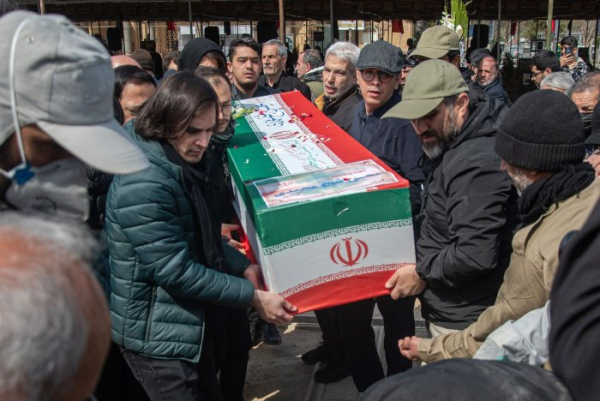
Iranians attend a funeral for a person killed in recent U.S.-Israel airstrikes at Behesht-e Zahra cemetery on the southern outskirts of Tehran in Iran on March 9, 2026. Photo by Hossein Esmaeili/UPI | License Photo
