


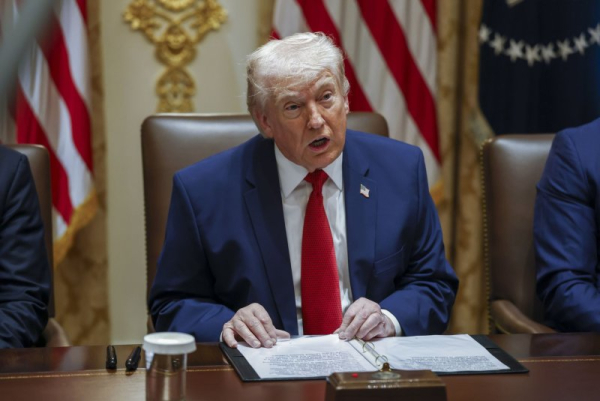
1 of 5 | President Donald Trump speaks during a Cabinet meeting at the White House in Washington D.C., on Thursday. Photo by Will Oliver/UPI | License Photo
President Donald Trump extended a pause on U.S. strikes on Iran’s energy sites because talks are going “well” and Iran permitted several oil tankers to transit the Strait of Hormuz.
Trump already had delayed threatened strikes on the country’s oil and gas sites after leaders of Iran’s ruling regime entered talks to end the weeks-long war until Friday.
“As per Iranian Government request … I am pausing the period of Energy Plant destruction by 10 Days to Monday, April 6, 2026, at 8 P.M., Eastern Time,” Trump posted on Truth Social Thursday afternoon.
“Talks are ongoing and, despite erroneous statements to the contrary by the Fake News Media, and others, they are going very well,” he said.
Trump later indicated that Iran permitting 10 oil tankers through the Strait as a show of good faith had influenced his decision to extend the pause.
Earlier Thursday, during the open portion of a Cabinet meeting, he told reporters that his administration has considered suspending the federal gas tax as oil prices climb higher amid the war in Iran.
“It’s something we have in our pocket if we think it’s necessary,” Trump said.
The federal tax on a gallon of gasoline is 18.4 cents, while the tax on diesel fuel is 24.40 cents, the U.S. Energy Information Administration website says. The average state tax on a gallon of gasoline is 32.61 cents and on diesel is 34.76 cents.
The national average cost for a gallon of gasoline was $3.981 on Thursday, and diesel was $5.375, a 33.6% and 43% increase since before the conflict in Iran, AAA reported.
A year ago, those prices were $3.150 and $3.606, respectively. On Feb. 27, the day before the bombing of Iran, they were $2.98 and $3.76.
The rise in fuel prices is a direct response to U.S. and Israeli attacks on Iran, which began Feb. 28 in an effort to limit Iran’s nuclear program. Tehran largely closed the Strait of Hormuz — through which 20% of the world’s oil is transported — to the United States and its allies.
It has become increasingly dangerous to transit the waterway between Iran and Oman amid ongoing violence in the region.
During Thursday’s Cabinet meeting, Trump told reporters that Iran had allowed 10 oil tankers to sail through the Strait of Hormuz as a “present” to the United States amid possible negotiations for a cease-fire. Trump cited a Fox News report for his information.
“They said something’s unusual happening,” he said of the report. “There are eight boats that are going middle of the Hormuz strait — eight big tankers are going loaded up with oil right through, and I said, ‘well, I guess they were right, and they were real, and I think they were Pakistani flagged.’ And I said, ‘well, I guess we’re dealing with the right people.’ ”
Trump said Iran allowed an additional two boats to pass through the strait. He told U.S. special envoy Steve Witkoff he hoped he hadn’t “screwed up” talks by mentioning the report.
The Trump administration has already taken steps to try to bring down fuel prices amid the Iran war. On March 18, he issued a 60-day temporary waiver of the 106-year-old maritime law known as the Jones Act.
The Jones Act requires that cargo traveling between U.S. ports be flagged in the United States, be at least 75% owned by U.S. citizens and be at least 75% crewed by U.S. citizens. The act, passed in 1920, was established to grow domestic shipping in the wake of World War I.
Using foreign vessels is expected to cut the transportation costs of fuel by about 5 cents per gallon.
Treasury Secretary Scott Bessent said the United States is also considering lifting sanctions on Iranian oil to slow rising gas prices.
This week in Washington
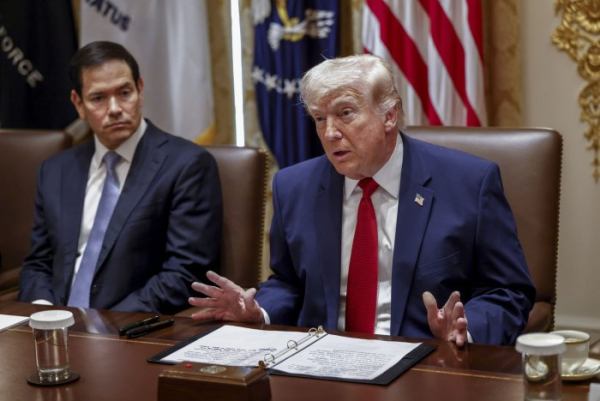
President Donald Trump speaks as Secretary of State Marco Rubio listens during a cabinet meeting at the White House on Thursday. Photo by Will Oliver/UPI | License Photo
