



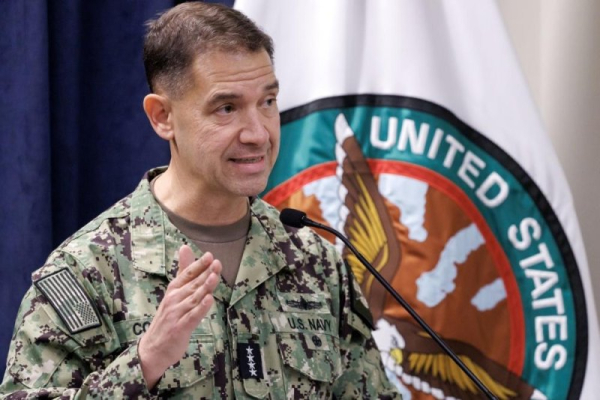
U.S. Central Command’s Adm. Brad Cooper contradicted recent reports that internal intelligence assessments given to senior U.S. officials showed that Iran retained most of its prewar missile capacity. File Photo by Cristobal Herrera-Ulashkevich/EPA
The war in Iran has “severely degraded” the Iranian regime’s military, the commander of U.S. military operations in the Middle East told lawmakers Thursday, flatly rejecting reports that most of Iran’s missile stockpiles and launchers remained functional.
In his testimony before the Armed Services Committee, U.S. Navy Adm. Brad Cooper, the head of U.S. Central Command, contradicted recent reports that internal intelligence assessments given to senior U.S. officials showed that Iran retained most of its prewar missile capacity.
“For 47 years, the Iranian regime has terrorized the region,” Cooper said. “In less than 40 days, Central Command achieved our military objectives.”
Central Command directs military operations in the Middle East, where more than 50,000 U.S. service members await the possible resumption of the war. Central Command also oversees the ongoing naval blockade of Iranian ports.
During the six-week war, Central Command forces struck more than 13,000 targets, including legions of Iranian military and intelligence sites. Despite battlefield successes, Cooper’s testimony arrived amid heightened bipartisan frustration over the growing cost of the conflict and the United States’ inability to extricate itself from it.
Sen. Richard Blumenthal, D-Conn., asked Cooper about recent reports estimating that despite six weeks of sustained bombardment, the Iranian regime retained upward of three-quarters of its inventories of mobile launchers and stockpiles of missiles.
The estimate, based on a confidential CIA assessment, was first reported by the Washington Post last week.
“The numbers I’ve seen in open source are not accurate,” Cooper responded.
Central Command’s mission was “crystal clear” from the outset, Cooper said, and it had three clearly defined components: wrecking Iran’s ballistic missile, drone and naval capabilities.
“Each of those systems was significantly degraded,” Cooper said. He added that Iran’s defense industrial base, which supported each of those levers of military power, had been reduced by 90%. “Iran won’t be able to reconstitute those weapons.”
Cooper conspicuously omitted from his list of objectives any mention of extinguishing Iran’s nuclear program. President Donald Trump and Secretary of Defense Pete Hegseth, however, have repeatedly pointed to the need to stop Iran from building a nuclear weapon as a cornerstone of the mission in Iran.
“The only thing that matters, when I’m talking about Iran, they can’t have a nuclear weapon,” Trump said Tuesday.
Iran retains its stockpile of nuclear material and its stranglehold on global shipping through its closure of the Strait of Hormuz, a vital waterway off the country’s coast through which about a quarter of the world’s seaborne oil trade travels.
The strait’s closure has sent energy prices soaring and wreaked havoc on the global economy. More than 1,500 vessels and about 20,000 mariners remain trapped inside the Persian Gulf, according to reports.
A Central Command operation to escort merchant vessels through the strait, shielding them from Iranian attack, ended abruptly last week after Trump called it off after two days. Central Command successfully escorted two U.S.-flagged ships through the strait during that time.
But Cooper told lawmakers that reopening the strait was within the military’s capability, if the administration gives the order again.
“From the military standpoint, we could [open the strait] again, could we not?” asked the committee’s chairman, Sen. Roger Wicker, R-Miss.
“We just did it last week,” Cooper replied.
In the most heated line of questioning during the otherwise cordial and subdued hearing, Sen. Kirsten Gillibrand, D-N.Y., grilled Cooper about reports of civilian casualties during the bombing campaign.
She specifically pointed to April reporting by The New York Times that found 22 Iranian schools and 17 medical facilities had been damaged in the bombardment.
“We have executed every operation consistent with the law of armed conflict,” Cooper said. “The subject of civilian casualties is a particular passion of mine.”
“How many schools have we bombed?” Gillibrand asked.
“There is one active civilian casualty investigation from 13,629 munitions,” Cooper responded, apparently referring to the investigation of a girls school in southern Iran that was struck Feb. 28, on the first day of the war, killing an estimated 156 people, including at least 120 students and 26 teachers.
Cooper said there was “no way” he could corroborate the claims of other schools or medical facilities being struck. But he said that Central Command had not investigated any other allegations of civilian harm.
The Tomahawk missile strike on the Shajareh Tayyebeh Elementary School would be the deadliest single U.S. attack on civilians in decades. The New York Times and other media outlets have reported that the department’s preliminary findings found that the mass-casualty event was the result of a targeting error by Central Command.
U.S. officers under Cooper’s command used outdated intelligence to derive the strike coordinates for what they thought was an Iranian military base, the preliminary findings said.
Earlier in the hearing, Cooper confirmed reports that as part of a department-wide move under Hegseth, the civilian harm mitigation team at Central Command had been gutted from 10 staff members to one.
