


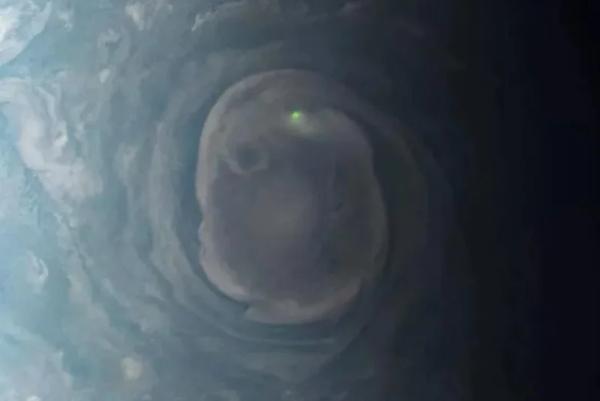
In December 2020, NASA’s Juno mission caught the visible glow from a bolt of lightning in a vortex near Jupiter’s north pole. Photo by NASA
NASA’s Juno spacecraft has been orbiting Jupiter for 10 years. During that time, it has studied the huge storms on the planet, such as the Great Red Spot, which is larger than Earth.
New data shows that lightning strikes inside Jupiter’s atmosphere may be more than 500 times as powerful than on Earth.
Lead author Michael Wong, a planetary scientist at UC Berkeley’s Space Sciences Laboratory, published the study in the journal AGU Advances.
“Convection operates a little bit differently on Earth and Jupiter because Jupiter has a hydrogen-dominated atmosphere, so moist air is heavier and harder to bring upward,” Wong said.
Almost every spacecraft passing by Jupiter has detected lightning in its atmosphere, and Juno even captured the glow from a bolt of lightning in 2020 in a storm near its north pole.
Wong used data from one of Juno’s core instruments, a microwave radiometer, to precisely measure the power of the lightning.
In 2021 and 2022, a lull in storms in the Northern Equatorial Belt produced a chance to study four single, large “stealth superstorms” without the background noise of lightning from the entire belt.
What he found was a lot of very strong lightning activity in the superstorm. On Aug. 16, 2022, Juno detected 613 pulses of microwave radiation coming from the lightning bolts.
On Earth, a single lightning bolt releases about 1 gigaJoule of energy, but Wong estimates that a Jupiter bolt contains between 500 and 10,000 times more power.
Why is Jupiter’s lightning so much more powerful?
Wong says the key difference could be that Jupiter’s atmosphere is mostly hydrogen, whereas Earth’s is mostly nitrogen.
But then again, Jupiter’s thunderstorms are more than 60 miles tall, while those on Earth rarely exceed 6 miles.
More research on that topic is needed to find the cause, Wong added.
Artemis II rocket rolls out to the launchpad in Florida
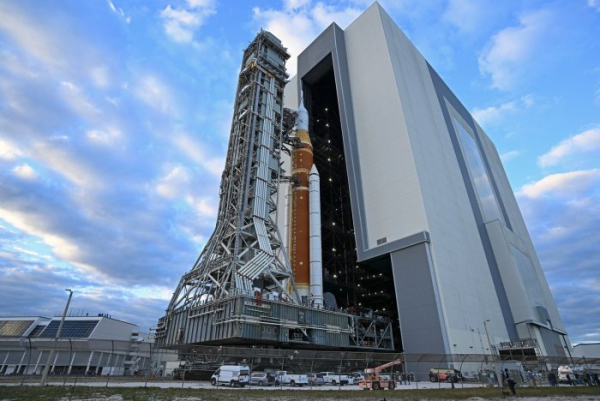
NASA’s Space Launch System rocket emerges on Saturday morning from the Vehicle Assembly Building to start its journey to Launch Complex 39B at the Kennedy Space Center in Florida. Photo by Joe Marino/UPI | License Photo
