


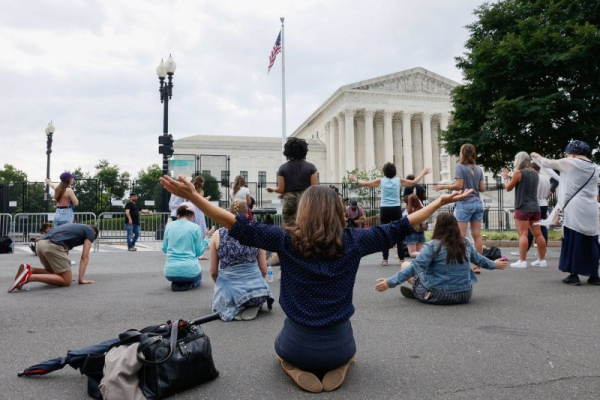
Demonstrators kneel in prayer in front of the U.S. Supreme Court during a praise and worship service at the U.S. Supreme Court in 2022. On Monday, the Court refused to hear a case brought by a Floriday Christian school that would change a ruling that disallows prayers over the loudspeaker at high school games. File Photo by Jemal Countess/UPI | License Photo
The U.S. Supreme Court on Monday declined to hear a case challenging a 25-year-old rule against broadcasting a prayer before a high school football game, keeping the ruling in place.
The challenge was brought by a Tampa-based Christian school that wanted to broadcast a prayer before a 2015 state championship football game.
The U.S. Court of Appeals for the 11th Circuit had ruled in favor of the Florida High School Athletic Association, found that use of the loudspeaker by the Christian schools to engage in communal prayer before a state-organized football game would be government speech.
The Tampa school, Cambridge Christian School, wanted the Court to overturn its 2000 decision in Santa Fe Independent School District v. Doe. In that ruling, the Court said that allowing student-led, student-initiated prayer at games violated the Establishment Clause in the First Amendment.
Since the incident, the state has passed legislation to allow opening remarks by students over the loudspeaker at state football games, which include prayer.
“The political branches have remedied the problem (Cambridge) brought this lawsuit to address without the need for judicial intervention,” lawyers for FHSAA told the court.
But the school argued the Supreme Court should prevent the “government speech” defense from being used in other situations.
“One way state actors suppress religious speech is by claiming private speech as their own,” lawyers for Cambridge told the court.
In the 2015 incident, Cambridge was playing in the 2A state championship game against University Christian at the Citrus Bowl in Orlando. Before the game, someone from University asked FHSAA for permission to say a prayer over the loudspeaker before the game.
When the school was told no, Cambridge asked Roger Dearing, executive director of FHSAA, to “allow two Christian schools to honor their Lord before the game and pray” over the loudspeaker.
Dearing said no because he believed federal law prevented him from granting permission to broadcast a pre-game prayer because the Citrus Bowl is a public facility and the FHSAA is a “state actor,” and therefore cannot allow communal prayer.
The athletics association instead suggested the two schools come together before the start of the game to pray, which they did.
After the game, Dearing cited the Santa Fe Independent School District case.
Cambridge then sued in 2016.
The conservative court ruled in 2022 that a high school football coach has the right to pray with students on the field after games. The school district had objected, saying that students felt obligated to participate.
